InfoSecBulletin Cybersecurity for mankind

Bangladeshi conglomerate Summit Group is entering Bangladesh’s rapidly growing data center market and plans to start working with an external business partner within a year, its chairman told in a recent interview.
The first data center would utilize the gas generation capacity of Summit Power International, the group’s energy arm and nation’s largest private power provider. However, Muhammed Aziz Khan, who founded the group 40 years ago, acknowledged slow progress in decarbonizing the company’s gas-heavy portfolio at a time when Bangladesh is targeting a reduction in planet-warming emissions.
Apple iOS 27.2 Released Fixes 163 Flaws, Including Critical WebKit RCE

CISA adds PHP2Shell to KEV, PHP Releases New Security Updates to Fix Critical HTTP2Shell flaw

Cloudflare Unveils Emergency WAF Ruleset Update on Brotli flaw

Daily Cyber security update for 26.10. 2026
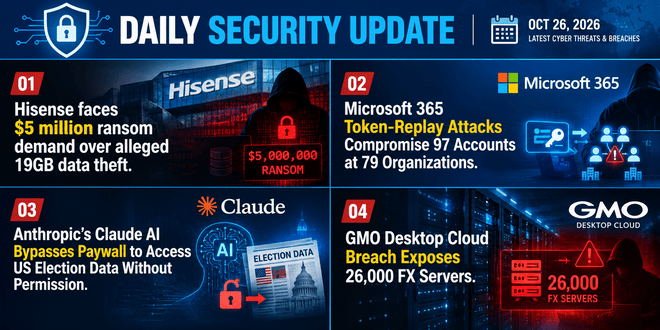
The Washington Post report
Ex-DOGE AI startup Cathedral Breaches Anthropic Internal Systems within 12 Hours

Daily Cyber security update for 25. 10. 2026

Daily Cyber security update for 24. 10. 2026

PHP shares new RCE flaw (CVE 2026-115560) with no patch but mitigation

US banks faced unauthorized access by AI agents in customer accounts: Axios reports

Atlassian patched 176 flaw in Jira and Confluence: Fortinet Urges to Patch Flaws Affecting FortiOS, FortiManager

“Summit Group’s next phase [of growth] focuses on integrating energy and data, leveraging our LNG and fiber-optic expertise,” Khan said in an online interview last month.
Summit Power accounts for 7% of Bangladesh’s total installed power capacity through 10 gas plants and five oil plants. The conglomerate also includes Summit Communications, which has established a nationwide fiber-optic network serving nearly half of national internet demand.
Demand for data centers in Bangladesh is rising due to increased internet and smartphone use, leading to more cloud services, mobile apps, and AI adoption. The government is investing in broadband expansion and digital infrastructure improvement, as noted by the Japan International Cooperation Agency (JICA), which also supports tech talent development.
Bangladesh’s Personal Data Protection Ordinance, adopted last year, could potentially restrict the transfer and processing of personal data abroad, thereby fueling greater need for domestic data centers, JICA expert Akihiro Shoji told.
“For now, private investment is limited to small-scale data centers due to vulnerabilities in power and internet infrastructure. Political instability is also a country risk,” he said. “But the nation’s potential to function as a regional data center hub is not low, as the domestic market is expected to grow steadily.”
Summit is now seeking customers with experience in building and marketing data centers. The partnership would help to develop a facility that is in line with the fast-evolving technological trends of data centers, according to Khan.
“Some of the ‘Magnificent 7’ have shown interest,” Khan said, referring to Alphabet, Amazon, Apple, Meta Platforms, Microsoft, Nvidia and Tesla. Summit is aiming to secure a customer this year.
The envisioned data center would likely be built in the vicinity of Dhaka near Summit Power’s gas plants.
In the booming data center market, Summit’s niche is speed, Khan said, as the group collectively has three key components at hand — electricity, fiber and land. While data centers can take several years to develop, he said the group can make them available for customers in a year and a half.
Bangladesh’s data centers require a lot of energy, which could impact climate goals. In 2024, only 2% of its energy came from renewables, but the government plans to increase this to 25% by 2035. To achieve this, more renewable sources are necessary, yet land for big solar or wind farms is limited in such a densely populated nation.
“Until about two years back, we were trying to target ourselves to be along with the whole world, [thinking] that by 2050 we should be disposing of all our hydrocarbon-based generation,” Khan said. “Now, Bangladesh’s circumstances as well as global circumstances have changed, so we have to recast that model” to include technologies like carbon capture.
The company aims to invest in solar and hydroelectric projects with India, Nepal, and Bhutan to bring clean energy to Bangladesh.
“But at this point in time, it is constrained by the bilateral relationships between these countries,” he said.
The nation’s first 500-megawatt offshore wind project, which Summit Power had been working on with Danish investors with the aim of implementing the first phase of development by 2026, has been delayed due to political uncertainty, according to Khan. While prefeasibility studies and some geographical studies have been completed.
Despite political unrest, Khan remained upbeat about business as the nation prepares for the parliamentary elections.
Summit Power, which is based in Singapore in order to gain better access to global investors, sees that potential backers of Bangladeshi projects are “very cautious” amid the political turmoil. But “the desire to invest into the opportunities of Bangladesh continues to exist,” Khan said, adding that the nation’s large middle-class population and strong export base were its “underlying strength.”
“For investment, the essential foundations are rule of law, democracy and policy predictability,” he said. “A prime minister elected by the people would hopefully be able to give at least five years of certainty in their policymaking.”
FortiWeb Devices in Bangladesh Exploited via CVE-2025-55182 to Deploy Sliver C2
How Millions of Illegal IMEI Phones Infiltrated Bangladesh’s Networks
BTRC NEIR face 2.4 million bot traffic in a minute
80 internet-exposed MongoDB database instances found in Bangladesh
Bangladesh now 3rd largest global source of DDoS attacks in 2025 Q