InfoSecBulletin Cybersecurity for mankind
A Fortinet FortiWeb vulnerability is being exploited to create new admin users on exposed devices without any authentication. The issue is fixed in FortiWeb 8.0.2, and admins are urged to update as soon as possible and check for signs of unauthorized access.
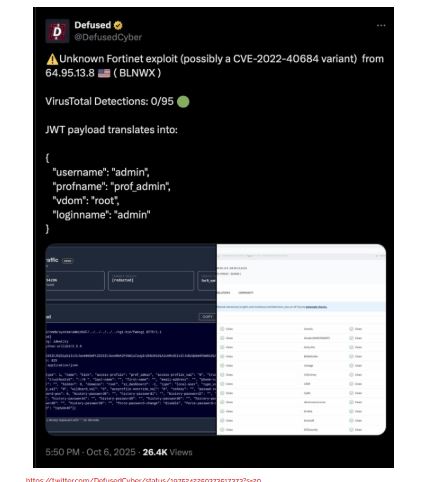
Threat intelligence firm Defused discovered an “Unknown Fortinet exploit” targeting exposed devices to create admin accounts on October 6.
CISA, NSA and NIST Publish New 10 AI Agent Control Guidelines
Claude AI Cracks 25-Year NSA Cryptography Number Mystery in Just 30 Minutes

Bypassing firewalls, AI Agents Accessed Indian ‘ Data Without Permission: CERT-In

MITRE ATT&CK v20 Unveils 9 New Attack Techniques On AI Exploits, MFA Bypass, and CAPTCHA Evasion

Hackers Exploit Fortinet Flaws to Deploy Stealthy PEERSTITCH Malware on FortiGate Firewalls

Hacker stole Meta GitHub repos; Stole Source Code

Urgent patch! Zoom,NVIDIA and IBM Patch 41 Security flaws

Microsoft patches record braking 1411 flaws; 2 zero days

Anthropic unveils “OSS Scanner” Free AI Vulnerability Scanner for Open-Source Projects

Rise on RCE Exploits Targeting Hikvision Camera Flaw

According to new research published by Daniel Card of PwnDefend and Defused, the flaw is a path traversal issue affecting the following Fortinet endpoint: (/api/v2.0/cmdb/system/admin%3f/../../../../../cgi-bin/fwbcgi)
Threat actors are sending HTTP POST requests to this path containing payloads that create local admin-level accounts on the targeted device.
Researchers found multiple sets of usernames and passwords like Testpoint, trader1, and trader, with passwords including 3eMIXX43, AFT3$tH4ck, and AFT3$tH4ckmet0d4yaga!n.
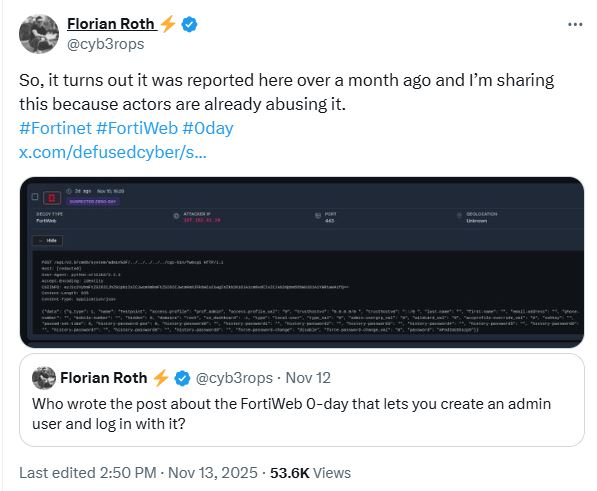
The attacks originated from a wide range of IP addresses, including:
107.152.41.19
144.31.1.63
Addresses in the 185.192.70.0/24 range
64.95.13.8 (from original October report)
Security researchers at watchTowr Labs have verified the exploit, sharing a video on X that shows a failed FortiWeb login attempt, the exploit execution, and the successful login as the new admin user.
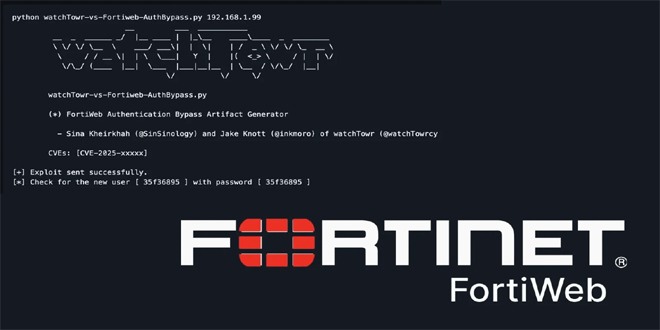
watchTowr also released a tool called “FortiWeb Authentication Bypass Artifact Generator,” which attempts to exploit the flaw by creating an admin user with an 8-character random username derived from a UUID.
The tool was released to help defenders identify vulnerable devices.
Rapid7 reports that the flaw impacts FortiWeb versions 8.0.1 and earlier. It was resolved in version 8.0.2, released at the end of October.
BleepingComputer reported an inability to find any disclosure of a FortiWeb vulnerability on Fortinet’s PSIRT site that matches the one being exploited.
WatchTowr Labs’ open-source tool, hosted on GitHub at watchTowr-vs-Fortiweb-AuthBypass, simplifies detection by simulating the bypass mechanism. The Python script generates a unique username and password (e.g., “35f36895”) and sends an exploit payload to the target IP, such as python watchTowr-vs-Fortiweb-AuthBypass.py 192.168.1.99.
Source: Defused, pwndefend, Daniel_Card, BleepingComputer