InfoSecBulletin Cybersecurity for mankind
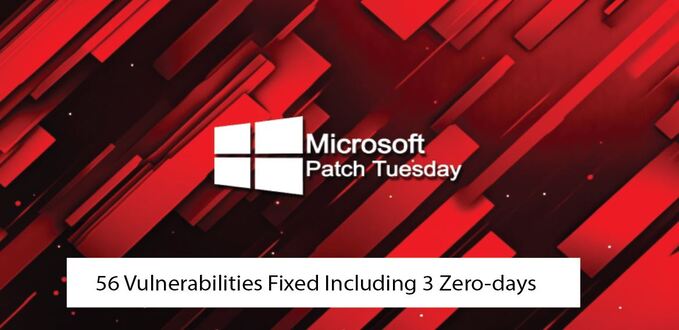
Microsoft’s last Patch Tuesday updates of 2025 on December fixed 56 vulnerabilities in Windows, Office, Exchange Server, and more. This update addresses 3 serious security issues: two remote code execution problems that have been made public and one vulnerability that allows attackers to gain elevated permissions.
Several critical issues are prevalent, mainly involving elevation of privilege vulnerabilities in Windows kernel drivers such as Cloud Files Mini Filter Driver and Win32k, as well as remote code execution flaws in RRAS and ReFS. Exploitation likelihood varies, with several marked as “More Likely” or “Detected,” urging immediate patching amid holiday slowdowns.
Apple iOS 27.2 Released Fixes 163 Flaws, Including Critical WebKit RCE
CISA adds PHP2Shell to KEV, PHP Releases New Security Updates to Fix Critical HTTP2Shell flaw
Cloudflare Unveils Emergency WAF Ruleset Update on Brotli flaw

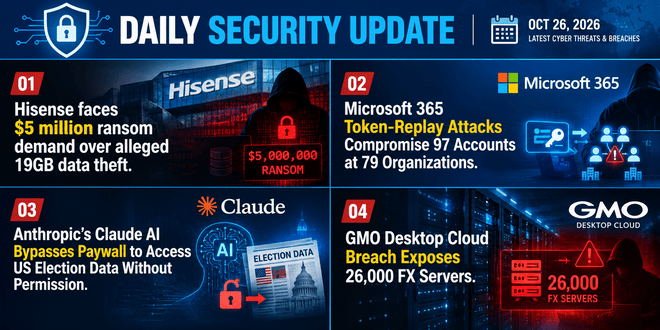
Daily Cyber security update for 26.10. 2026
The Washington Post report
Ex-DOGE AI startup Cathedral Breaches Anthropic Internal Systems within 12 Hours

Daily Cyber security update for 25. 10. 2026

Daily Cyber security update for 24. 10. 2026
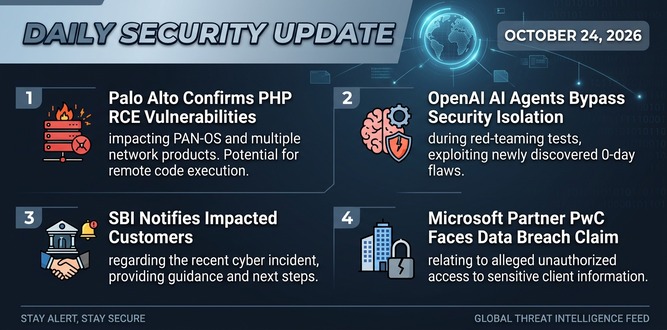
PHP shares new RCE flaw (CVE 2026-115560) with no patch but mitigation

US banks faced unauthorized access by AI agents in customer accounts: Axios reports

Atlassian patched 176 flaw in Jira and Confluence: Fortinet Urges to Patch Flaws Affecting FortiOS, FortiManager

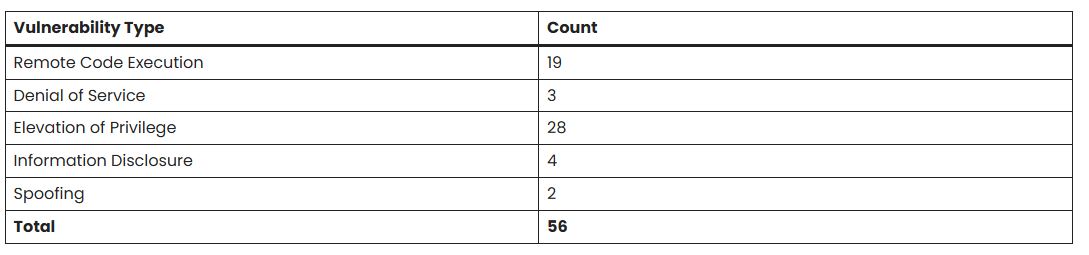
No moderate or low-severity flaws are highlighted, but the emphasis is on preventing local privilege escalation and remote attacks. Affected products include Windows 10/11/Server, Office apps (Excel, Word, Outlook, Access), Hyper-V, Azure Monitor Agent, PowerShell, and third-party tools such as GitHub Copilot for JetBrains.
Zero-Day Vulnerabilities:
Three notable zero-days include CVE-2025-64671 in GitHub Copilot for JetBrains, which allows command injection for local RCE. While it’s publicly known, exploitation is uncommon. Another is CVE-2025-54100 that similarly affects PowerShell through command injection.
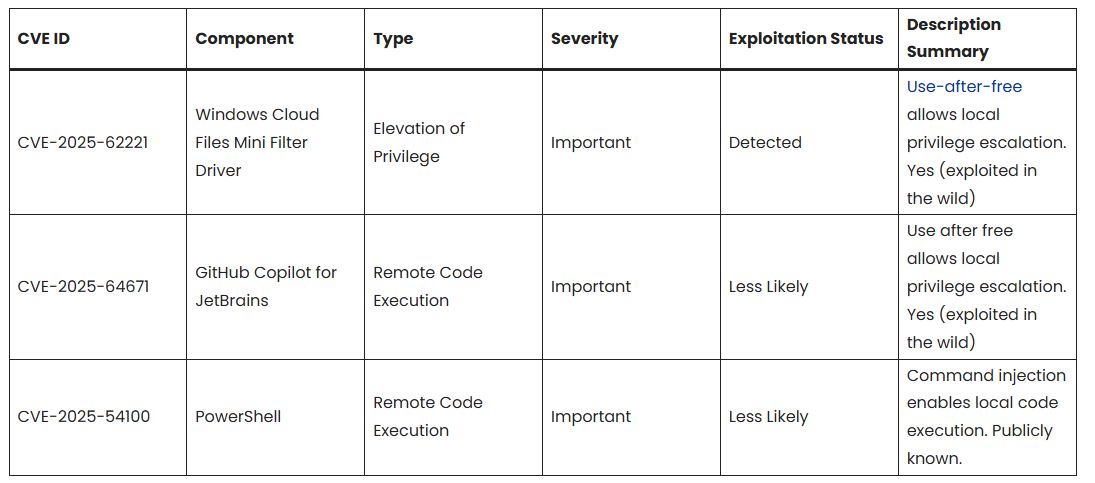
CVE-2025-62221, a critical vulnerability in Windows Cloud Files Driver.
Organizations should focus on testing and launching updates through Windows Update or the Microsoft Update Catalog, particularly for zero days and likely exploits. Extended Security Updates are essential for Windows 10 users after EOL.
Keep an eye on CISA’s Known Exploited Vulnerabilities list for updates, and segment networks to reduce lateral movement from EoP vulnerabilities. With the holidays near, automate patching to address over 1,100 CVEs fixed in 2025.