 InfoSecBulletin Cybersecurity for mankind
Bangladesh, Pakistan, Nepal, Sri Lanka and China among targeted countries; attackers use fake government domains and malicious Microsoft Office documents.
BGD e-GOV CIRT, has issued a high-severity cyber threat advisory warning of a targeted spear-phishing campaign attributed to the SideWinder Advanced Persistent Threat (APT) group. The campaign uses government impersonation domains and weaponized Microsoft Office documents to deliver malicious second-stage content.
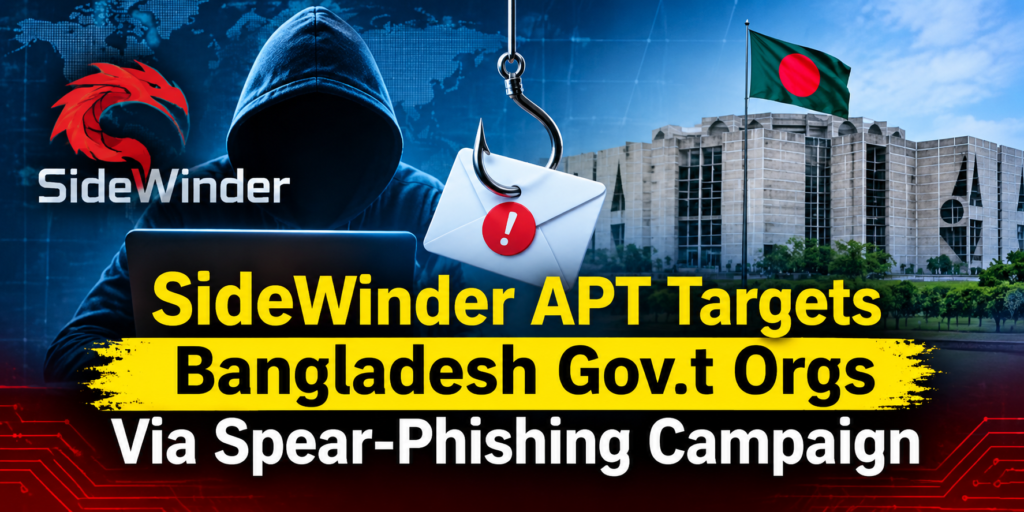
SideWinder APT Targets Bangladesh Gov.t Orgs Via Spear-Phishing Campaign
Daily Cyber security update for 23.11. 2026
WhatsApp fixes 3 security flaws, including a suspected Android scam bug
Visa, Mastercard, JPMorgan said third-party vendors incidents amid data leak
PHP updates fix 18 flaws, with critical RCE bugs included

F5 Issues Out-of-Band Security Advisory Covering 22 Flaws Across NGINX and BIG-IP Products

Over 1 million credit cards stolen in attack across 20 countries
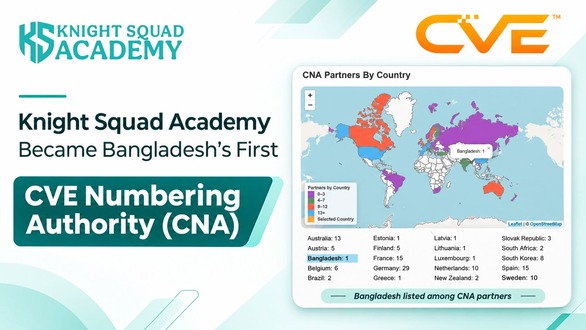
Knight Squad Academy now serves as Bangladesh’s first CVE Numbering Authority
Daily Cyber security update for 18.11. 2026
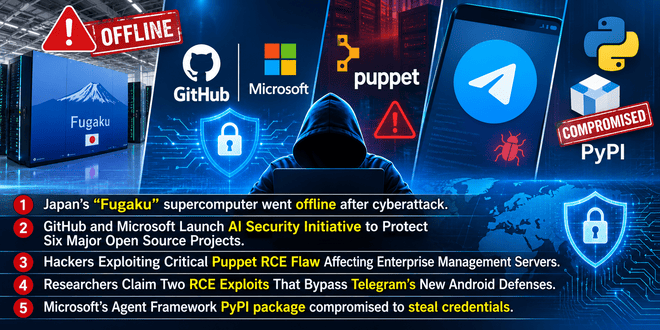
Japan’s “Fugaku” supercomputer went offline after cyberattack

According to the advisory published on November 23, 2026, the campaign was observed between November 2 and November 12, targeting government and military-related organizations across Bangladesh, Pakistan, Nepal, Sri Lanka and China. The targeted sectors include government administration, military and defense, and energy.
Particularly concerning for Bangladesh, investigators identified malicious domains impersonating the country’s Ministry of Foreign Affairs and Directorate of Secondary and Higher Education.
The two Bangladesh-related lookalike domains identified in the investigation are:
mofa-gov-bd.fetchdrives[.]info
dshe-gov-bd.fetchdrives[.]info
However, BGD e-GOV CIRT emphasized that identifying these domains does not establish that phishing emails were successfully delivered to the respective institutions or that any Bangladeshi government system was compromised.
Malicious Microsoft Office Documents Used for Initial Access
The campaign begins with targeted spear-phishing emails containing malicious Microsoft Office documents. Attackers reportedly use government-related administrative themes to increase the likelihood that recipients will open the attachments.
The observed document themes include:
Government pay-scale revisions
Official travel advisories
Government training schedules
Administrative notices and institutional communications
Investigators identified five first-stage Office Open XML (DOCX) documents. One particularly deceptive file was named `Revision of Basic Pay Scales_2026.zip`, although its internal structure was actually a DOCX document.
This technique could bypass security controls that rely exclusively on filename extensions to identify potentially malicious attachments.
Remote Template Injection Delivers Malicious Payload
A key technique identified in the campaign is remote template injection, which allows Microsoft Word to retrieve an externally hosted template when a weaponized document is opened.
The malicious reference is embedded in the document’s internal relationship file:
word/_rels/document.xml.rels
When a recipient opens the document in Microsoft Word, the application attempts to retrieve an external resource over HTTPS. The process does not require the user to enable macros, making traditional macro-blocking protections insufficient to prevent this initial retrieval mechanism.
The investigation documented a suspicious network request sequence involving Microsoft Word:
OPTIONS → HEAD → OPTIONS
These WebDAV-style requests are directed toward attacker-controlled infrastructure rather than legitimate Microsoft services.
The retrieved second-stage file is named `Fontlayer.rtf`. Researchers found that the file contains an unusual RTF header — `Rich Text Format data, version 2, ANSI` — instead of the conventional `{\rtf1` format. This malformed structure could cause conventional file-identification tools to misclassify or fail to recognize the file.
Two Malicious Domains and 14 Lookalike Hostnames Identified
The investigation identified two primary domains associated with the campaign:
donwloaad-file[.]org
fetchdrives[.]info
Researchers also identified two associated IP addresses:
89[.]46[.]237[.]186
168[.]222[.]243[.]49
According to the advisory, 14 government and organization-themed lookalike hostnames were identified beneath the attacker-controlled infrastructure.
These domains impersonate institutions in multiple countries, including Pakistan’s finance and commerce ministries, Nepal’s foreign and home affairs ministries, Bangladesh’s foreign affairs and education authorities, Sri Lanka’s public administration and China’s National Energy Administration.
The attackers also use unique URL paths for individual recipients. These paths contain campaign identifiers, target identifiers and unique file tokens, potentially allowing the operators to distinguish recipients and track document access.
Another notable technique involves an internationalized domain name (IDN) homoglyph. By substituting a Unicode hyphen for a standard ASCII hyphen, attackers create visually similar domain names that may evade basic string-matching security controls.
Malware Execution and Data Theft Not Confirmed
Although the investigation established the delivery of malicious documents and retrieval of the second-stage RTF file, BGD e-GOV CIRT could not independently confirm subsequent malware execution.
The advisory specifically notes that the available evidence does not establish successful execution of a third-stage payload, command-and-control (C2) communication, persistence mechanisms, lateral movement or data exfiltration.
Some sandbox observations reported files named `StikyNote.exe` and `jusched.exe` in suspicious locations. However, these artifacts were not independently reproduced in the analyzed samples and should be treated as secondary threat-hunting leads rather than confirmed evidence of successful compromise.
The attribution to SideWinder was assessed with high confidence based on multiple technical and behavioral observations, including malware-family identification, remote template injection, malformed RTF files, infrastructure patterns and document metadata.
BGD e-GOV CIRT Recommends Immediate Security Measures
BGD e-GOV CIRT has urged government organizations, critical information infrastructure (CII) entities and other potentially exposed organizations to strengthen their cybersecurity monitoring and defensive controls.
Key recommendations include:
Email Security
Strengthen email gateway filtering for suspicious Office attachments.
Inspect actual file formats rather than relying solely on filename extensions.
Quarantine documents containing unexpected external template references.
Use sandbox analysis for suspicious documents.
Microsoft Office Security
Restrict unnecessary external template retrieval.
Apply the latest Microsoft Office security updates.
Monitor Microsoft Word processes initiating external network connections.
Implement appropriate Attack Surface Reduction rules and application-control policies.
Network and Endpoint Security
Monitor DNS queries and proxy traffic involving the identified malicious domains and IP addresses.
Detect suspicious outbound HTTPS connections initiated by `WINWORD.EXE`.
Monitor unusual HTTP request sequences, particularly OPTIONS, HEAD and OPTIONS.
Update endpoint detection and antivirus solutions.
Investigate suspicious files and preserve endpoint evidence.
For Bangladesh-specific protection, the advisory recommends reviewing DNS and proxy logs for the identified government lookalike domains, notifying relevant internal security teams, sharing indicators with SOC and incident response teams, and reporting suspected incidents to BGD e-GOV CIRT.
The advisory highlights an increasingly deceptive approach to targeted cyber operations: exploiting trust in official government communications rather than relying solely on conventional malicious attachments.
While no successful compromise of a specific Bangladeshi institution has been confirmed, the presence of Bangladesh-related impersonation infrastructure makes the campaign an important warning for government agencies and organizations handling sensitive administrative information.
Related news:
Hackers Register 18K Domains Targeting ‘Christmas,’ ‘Black Friday,’ and ‘Flash Sale’
Knight Squad Academy now serves as Bangladesh’s first CVE Numbering Authority
Bangladeshi Researcher Rasel Earns First Apple CVE Recognition for Model I/O Flaw