 InfoSecBulletin Cybersecurity for mankind

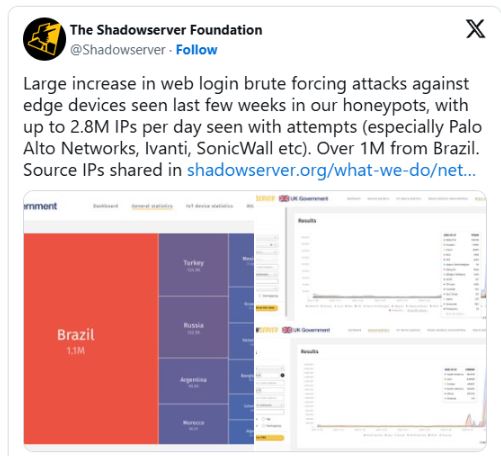
The Shadowserver Foundation reports that a brute force attack has been active since last month, using nearly 2.8 million IP addresses each day attempting to guess the credentials for a wide range of networking devices.
A brute force attack occurs when attackers repeatedly try different usernames and passwords to access an account or device until they find the right combination. Once they gain access, they can hijack the device or network.
PHP shares new RCE flaw (CVE 2026-115560) with no patch but mitigation

US banks faced unauthorized access by AI agents in customer accounts: Axios reports

Atlassian patched 176 flaw in Jira and Confluence: Fortinet Urges to Patch Flaws Affecting FortiOS, FortiManager

Hacker claim to access Rajasthan Police data: 70,000 records allegedly exposed

Update now! PHP2Shell: Critical PHP vulnerabilities patched

Trump says data centres should pay dividends to local community

Hackers Actively Exploiting Palo Alto VPN Flaw Via CVE-2026-0257

DeepSeek AI banned by U.S. Government; federal agencies must remove all related tools

CISA, NSA and NIST Publish New 10 AI Agent Control Guidelines
Claude AI Cracks 25-Year NSA Cryptography Number Mystery in Just 30 Minutes

The majority of the 1.1 million participants come from Brazil, followed by Turkey, Russia, Argentina, Morocco, and Mexico with many other as source of origin.
These are security devices like firewalls, VPNs, and gateways that are often connected to the internet for remote access.
The attacks mostly involve compromised MikroTik, Huawei, Cisco, Boa, and ZTE routers and IoT devices, often controlled by large malware botnets.
BleepingComputer reports that the Shadowserver Foundation has confirmed that this activity has been ongoing for some time but has recently intensified significantly.
ShadowServer reported that the attacking IP addresses come from various networks and Autonomous Systems, suggesting they may be part of a botnet or linked to residential proxy networks.
To protect edge devices from brute-force attacks, change the default admin password to a strong, unique one, enable multi-factor authentication (MFA), use an allowlist of trusted IPs, and disable unnecessary web admin interfaces.
U.K. orders Apple to let it spy on users’ encrypted accounts: Report