InfoSecBulletin Cybersecurity for mankind

TP-Link Systems has released a firmware update that fixes four serious vulnerabilities in its Omada gateway series, like ER605, ER7206, and ER8411, commonly used in businesses. These flaws—CVE-2025-6541, CVE-2025-6542, CVE-2025-7850, and CVE-2025-7851—can let attackers run arbitrary commands on the devices, sometimes without needing authentication.
According to TP-Link’s advisory, “An arbitrary OS command may be executed on Omada gateways by the user who can log in to the web management interface or by a remote unauthenticated attacker.”
CISA, NSA and NIST Publish New 10 AI Agent Control Guidelines
Claude AI Cracks 25-Year NSA Cryptography Number Mystery in Just 30 Minutes

Bypassing firewalls, AI Agents Accessed Indian ‘ Data Without Permission: CERT-In

MITRE ATT&CK v20 Unveils 9 New Attack Techniques On AI Exploits, MFA Bypass, and CAPTCHA Evasion

Hackers Exploit Fortinet Flaws to Deploy Stealthy PEERSTITCH Malware on FortiGate Firewalls

Hacker stole Meta GitHub repos; Stole Source Code

Urgent patch! Zoom,NVIDIA and IBM Patch 41 Security flaws

Microsoft patches record braking 1411 flaws; 2 zero days
Anthropic unveils “OSS Scanner” Free AI Vulnerability Scanner for Open-Source Projects
Rise on RCE Exploits Targeting Hikvision Camera Flaw

The two most critical vulnerabilities are:
CVE-2025-6542 (CVSS 9.3 – Critical): Enables remote unauthenticated attackers to execute arbitrary OS commands.
CVE-2025-6541 (CVSS 8.6 – High): Allows authenticated users to execute arbitrary commands through the web management interface.
Both vulnerabilities impact several Omada gateway models, risking full system compromise for network administrators if not fixed. TP-Link warns that “Attackers may execute arbitrary commands on the device’s underlying operating system.”
In addition to the above, TP-Link has disclosed two related command injection issues affecting the same product line:
CVE-2025-7850 (CVSS 9.3): A command injection vulnerability may be exploited after the admin’s authentication on the web portal on Omada gateways.
CVE-2025-7851 (CVSS 8.7): An attacker may obtain the root shell on the underlying with restricted conditions on Omada gateways.
Authenticated users or anyone with compromised admin credentials could gain root access, bypassing all device protections.
The following Omada products are impacted by one or more of the above vulnerabilities:
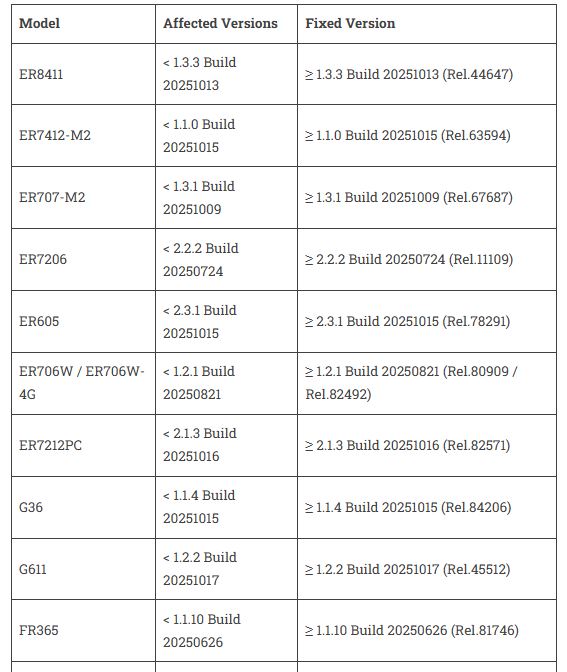
TP-Link urges all customers to promptly install the latest firmware updates to reduce risks from these vulnerabilities.
Administrators should check device settings and change admin passwords after the update to avoid exploitation from leaked credentials. TP-Link suggests limiting management access to trusted networks and using network segmentation when possible.