InfoSecBulletin Cybersecurity for mankind
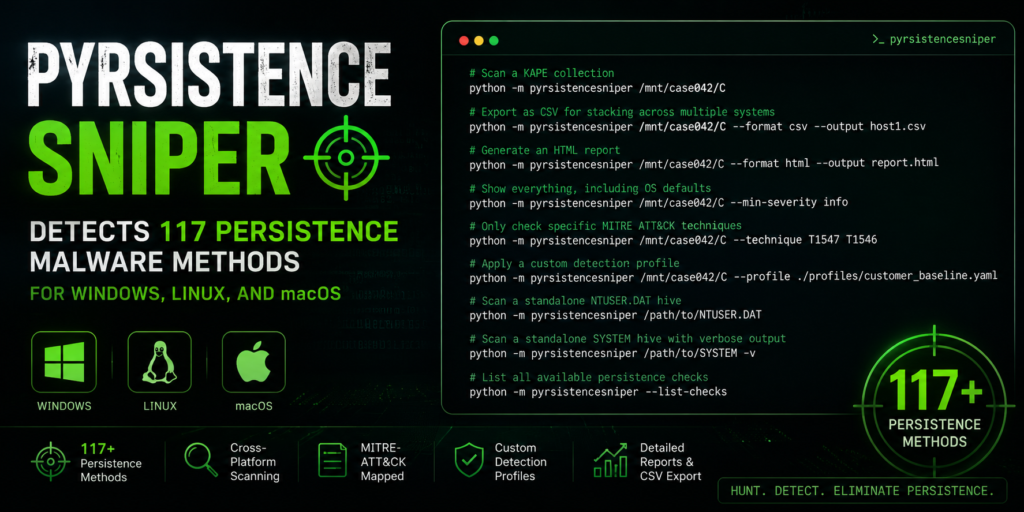
PyrsistenceSniper is a smart tool that finds offline persistence. It helps cybersecurity experts spot 117 different ways to maintain persistence on Windows, Linux, and macOS.
PyrsistenceSniper works with mounted disk images, Velociraptor collections, and KAPE dumps, based on the Hexastrike GitHub page. It uses the libregf library to read registry hives directly, which helps it scan busy systems in less than thirty seconds.
Daily Cyber security update for 25. 10. 2026

Daily Cyber security update for 24. 10. 2026

PHP shares new RCE flaw (CVE 2026-115560) with no patch but mitigation

US banks faced unauthorized access by AI agents in customer accounts: Axios reports

Atlassian patched 176 flaw in Jira and Confluence: Fortinet Urges to Patch Flaws Affecting FortiOS, FortiManager

Hacker claim to access Rajasthan Police data: 70,000 records allegedly exposed

Update now! PHP2Shell: Critical PHP vulnerabilities patched

Trump says data centres should pay dividends to local community

Hackers Actively Exploiting Palo Alto VPN Flaw Via CVE-2026-0257

DeepSeek AI banned by U.S. Government; federal agencies must remove all related tools

PyrsistenceSniper Detects 117 Persistence Techniques
The command-line tool shows clear terminal output that highlights unusual activities based on known MITRE ATT&CK methods.
pip install pyrsistencesniper # Scan a KAPE collection python -m pyrsistencesniper /mnt/case042/C # HTML report for client delivery python -m pyrsistencesniper /mnt/case042/C –format html –output report.html # Filter to specific ATT&CK techniques python -m pyrsistencesniper /mnt/case042/C –technique T1547 T1546
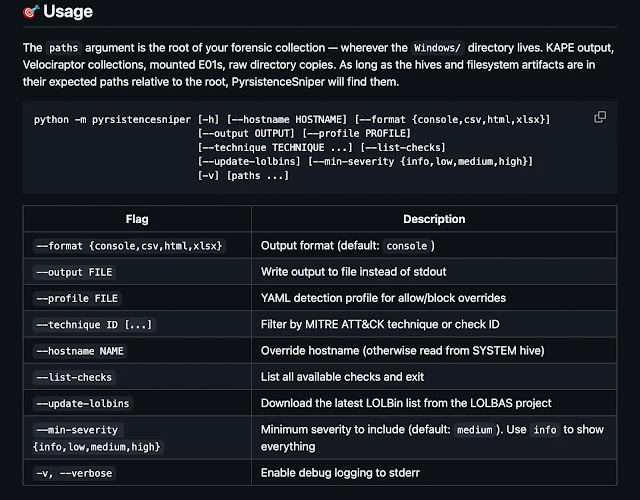
Security researchers say that PyrsistenceSniper can scan single files, like NTUSER.DAT or the SYSTEM hive. This is helpful when full folder structures are not there.
Networksecurity solutionsKey capabilities
Signature-based filtering: Authenticode validation separates legitimate OS defaults from persistence entries, including swapped binaries and DLL proxying that value-based whitelists miss.
YAML detection profiles: Allow and block rules configurable globally or per-check. Adapt checks to customer baselines without modifying the codebase.
Finding enrichment: Every result is automatically annotated with file existence, SHA-256 hash, Authenticode signer, and LOLBin classification.
Single-file plugin system: Adding a new persistence check requires only one file. Declarative checks need no method overrides; complex logic overrides a single run() method.
Maurice Fielenbach says that every discovery includes file checks, SHA-256 hashes, and recognized LOLBin types to make the response to incidents easier.
Cybersecurity experts can use YAML files to set up custom rules to allow or block actions for everyone or for specific checks. Hexastrike documentation says this system focuses on block rules. It automatically marks matches as high severity and removes trusted items like Microsoft-signed files.
Threat hunters say this system cuts down on extra alerts. It can lower total alerts by as much as ninety percent when analyzing data. Threat detection software Hexastrike linked its special checks for staying hidden with nine specific MITRE ATT&CK methods to make sure threat reports are clear.
PyrsistenceSniper covers 117 checks spanning the most commonly abused Windows persistence vectors:
| MITRE ID | Technique | Checks |
|---|---|---|
| T1547 | Boot/logon autostart execution | 43 |
| T1546 | Event triggered execution | 36 |
| T1574 | Hijack execution flow | 24 |
| T1137 | Office application startup | 7 |
| T1543 | Create or modify system process | 3 |
| T1053 | Scheduled task / job | 2 |
| T1556 | Modify authentication process | 2 |
Security teams use these categories to monitor methods from stolen execution paths to changed login processes in hacked systems. The table below shows some specific persistence techniques found by PyrsistenceSniper.
Forensic investigators can save PyrsistenceSniper results in different formats. These formats include console, CSV, HTML, and XLSX. This helps them fit well with their current analysis work.
Recent updates, highlighted by Maurice Fielenbach, introduced interactive HTML reports that allow defenders to dynamically filter and sort severity ratings.
PromptSpy: First Android AI Malware Uses Google’s Gemini for Decisions