 InfoSecBulletin Cybersecurity for mankind
Threat intelligence firm GreyNoise blog post claims that threat actors have exploited multiple vulnerabilities to compromise two dozen Check Point Security Management servers in an ongoing campaign targeting 22 organizations.
The researchers followed the activity called GT13 and found it was happening from October 17 to November 2, when they could no longer see it.
GreyNoise blog post
Hackers compromise Check Point servers in 22 orgs across 17 countries
SideWinder APT Targets Bangladesh Gov.t Orgs Via Spear-Phishing Campaign

Daily Cyber security update for 23.11. 2026

WhatsApp fixes 3 security flaws, including a suspected Android scam bug

Visa, Mastercard, JPMorgan said third-party vendors incidents amid data leak

PHP updates fix 18 flaws, with critical RCE bugs included

F5 Issues Out-of-Band Security Advisory Covering 22 Flaws Across NGINX and BIG-IP Products

Over 1 million credit cards stolen in attack across 20 countries

Knight Squad Academy now serves as Bangladesh’s first CVE Numbering Authority
Daily Cyber security update for 18.11. 2026

GreyNoise reports that the 22 victim organizations are in 17 countries and do not appear to be specifically targeted. These organizations include government bodies, financial service companies, and businesses in energy, transport, mining, and manufacturing.
The attacks came from 99 IP addresses that seem to be from compromised Check Point devices and ExpressVPN exit points.
A Rejetto HTTP File Server, compromised by exploiting CVE-2026-61500, was used as an operational relay for managing intrusions and collecting stolen data from the compromised environments.
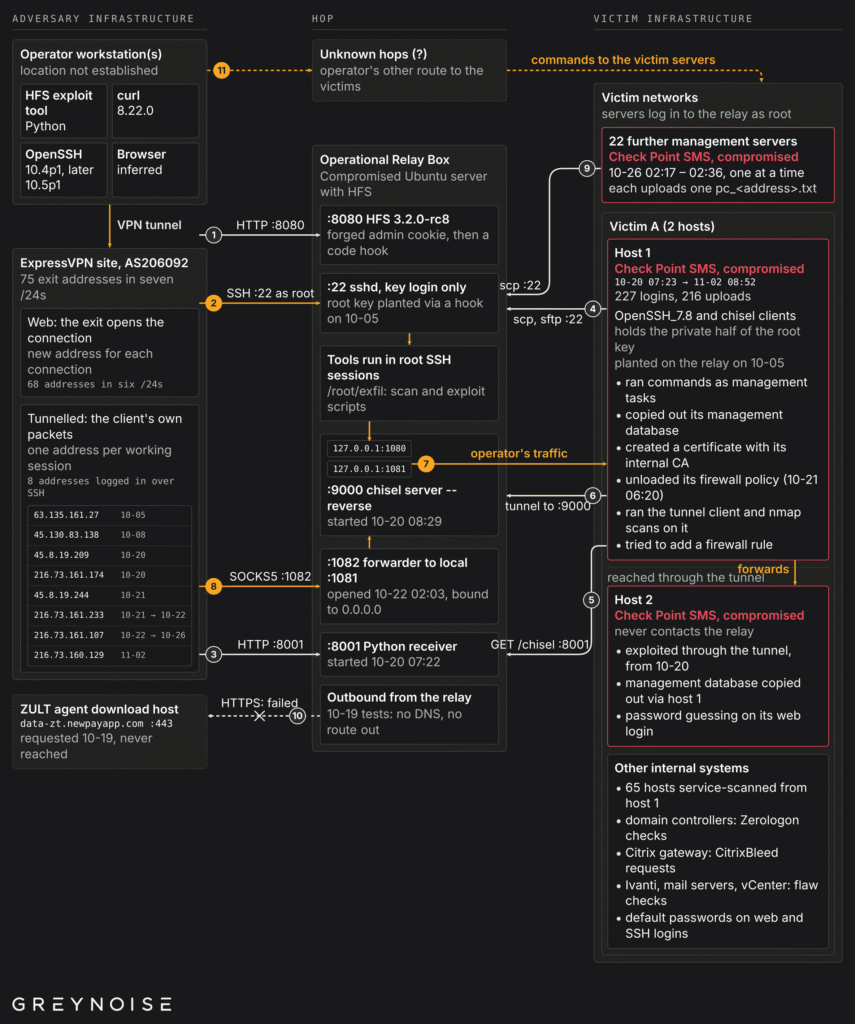
While GreyNoise could not determine when or how the Check Point servers were breached, it observed the exploitation of CVE-2026-16232 during the post-compromise stages.
The flaws lets attackers skip login in Check Point SmartConsole. They can get a login token and access the system as an admin.
Check Point warned about the flaw in July, marking it as an actively exploited zero-day.
The researchers also observed attempts to exploit CVE-2025-5777 (Citrix NetScaler), CVE-2024-21893 (Ivanti), CVE-2026-41089 (Windows NetLogon), CVE-2026-16232 (Check Point SmartConsole auth bypass to Run Script), and CVE-2026-98432 (Linux IPv4 UAF).
GreyNoise recorded over 1,400 network sessions, 800 command-line artifacts, and 1,200 file-related activities, such as:
Stealing firewall databases, credentials, configuration data, and internal certificate authority files.
Generating a new certificate in one victim’s environment.
Unloading security policies, effectively disabling firewall protections.
Conducting internal network reconnaissance and attempting lateral movement.
Targeting additional enterprise systems, including Citrix NetScaler (CVE-2023-4966), Ivanti Connect Secure (CVE-2024-21893), VMware vCenter (CVE-2021-21972 and CVE-2023-34048), Microsoft Exchange (CVE-2021-26855/34473), and Microsoft Netlogon (CVE-2020-1472).
On October 26, the attacker tried to manage lots of certificates on 24 compromised Check Point servers. It didn’t work, but it helped GreyNoise find victims.
The researchers think that GT13 used an AI tool for attacks. They based this on behavior, seen automation, and special tools. However, the use of AI in this campaign is not confirmed.
GreyNoise stopped seeing the campaign operations on November 2, but the researchers think it might still be happening. They have informed international government partners and CERTs to warn affected organizations.
The company also shared indicators of compromise (IoCs) that could help identify additional intrusions or block future attempts.
Source: GreyNoise, Bleepingcomputer