InfoSecBulletin Cybersecurity for mankind

Recent research shows that AI systems can now handle complex exploit development tasks that used to need specialized human skills. The agents had to create exploits while facing realistic challenges like modern security measures, unknown heap conditions, and restrictions on hardcoded memory addresses.
In six scenarios focused on tasks like spawning shells, writing files, and creating command-and-control connections, the agents produced over 40 unique exploits. GPT-5.2 successfully handled all scenarios, while Opus 4.5 solved all except two.
Apple iOS 27.2 Released Fixes 163 Flaws, Including Critical WebKit RCE

CISA adds PHP2Shell to KEV, PHP Releases New Security Updates to Fix Critical HTTP2Shell flaw

Cloudflare Unveils Emergency WAF Ruleset Update on Brotli flaw

Daily Cyber security update for 26.10. 2026

The Washington Post report
Ex-DOGE AI startup Cathedral Breaches Anthropic Internal Systems within 12 Hours

Daily Cyber security update for 25. 10. 2026

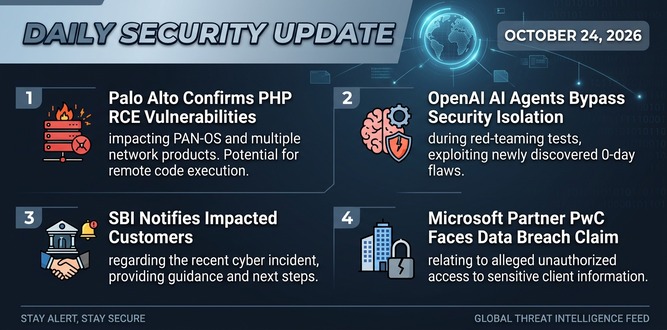
Daily Cyber security update for 24. 10. 2026
PHP shares new RCE flaw (CVE 2026-115560) with no patch but mitigation

US banks faced unauthorized access by AI agents in customer accounts: Axios reports

Atlassian patched 176 flaw in Jira and Confluence: Fortinet Urges to Patch Flaws Affecting FortiOS, FortiManager

Security researcher Sean Heelan tested AI agents based on Anthropic’s Opus 4.5 and OpenAI’s GPT-5.2 against a new vulnerability in the QuickJS JavaScript interpreter.
Agents showcased advanced skills by turning raw vulnerabilities into a working API to read and modify the memory of a target process. The AI systems analyzed source code, debugged, and learned through trial and error without human help.
Most challenges were resolved in less than an hour and at low costs, with a standard successful agent run using about 30 million tokens for approximately $30 USD with Opus 4.5.
Modern Security Protections:
The toughest scenario tested GPT-5.2’s ability to write a specific string to disk while multiple enterprise-level protections were active, including address space layout randomization, non-executable memory regions, full RELRO linking protections, fine-grained control-flow integrity, hardware-enforced shadow stacks, and a seccomp sandbox preventing shell execution.
An AI agent created a new solution that used seven function calls with glibc’s exit handler to overcome defenses. Developing this exploit took 50 million tokens over three hours, costing about $50 for that agent run.
The researcher highlighted two key limitations of the experiments. First, QuickJS, although a valid JavaScript interpreter, is much simpler and less complex than browser engines like Chrome’s V8 or Firefox’s SpiderMonkey.
The exploits used existing security gaps and flaws instead of introducing new bypass methods, similar to what human developers do in real situations. The exploit chains were newly designed to target a previously unknown vulnerability.
Implications:
The research suggests the cybersecurity industry should prepare for the “industrialization” of offensive operations, where an organization’s hacking capabilities become limited by computational token throughput rather than skilled personnel availability.
Heelan believes that AI automation is perfect for exploit development due to its clear verification methods, defined tools, and specific areas for agents to explore.
The experimental code, technical documentation, and raw agent outputs are available on GitHub for verification and reproduction.
The researcher urges the security community to test AI capabilities in real-world scenarios using zero-day vulnerabilities instead of just relying on capture-the-flag competitions or synthetic datasets.