 InfoSecBulletin Cybersecurity for mankind

Fortinet warns customers of a critical security flaw in FortiSIEM which it said there exists an exploit in the wild. CVE-2025-25256 is a critical vulnerability with a CVSS score of 9.8 out of 10.
“An improper neutralization of special elements used in an OS command (‘OS Command Injection’) vulnerability [CWE-78] in FortiSIEM may allow an unauthenticated attacker to execute unauthorized code or commands via crafted CLI requests,” the company said in a Tuesday advisory.
Daily Cyber security update for 25. 10. 2026

Daily Cyber security update for 24. 10. 2026
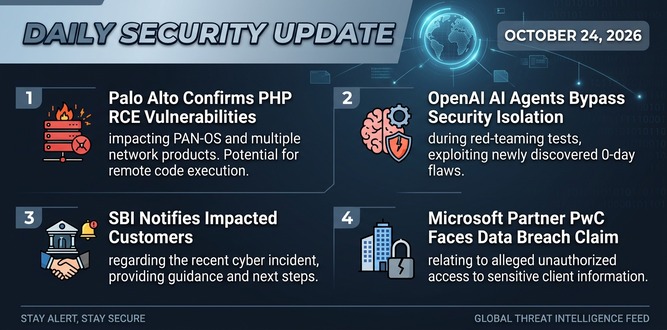
PHP shares new RCE flaw (CVE 2026-115560) with no patch but mitigation

US banks faced unauthorized access by AI agents in customer accounts: Axios reports

Atlassian patched 176 flaw in Jira and Confluence: Fortinet Urges to Patch Flaws Affecting FortiOS, FortiManager

Hacker claim to access Rajasthan Police data: 70,000 records allegedly exposed

Update now! PHP2Shell: Critical PHP vulnerabilities patched

Trump says data centres should pay dividends to local community

Hackers Actively Exploiting Palo Alto VPN Flaw Via CVE-2026-0257

DeepSeek AI banned by U.S. Government; federal agencies must remove all related tools

The following versions are impacted by the flaw:
FortiSIEM 6.1, 6.2, 6.3, 6.4, 6.5, 6.6 (Migrate to a fixed release)
FortiSIEM 6.7.0 through 6.7.9 (Upgrade to 6.7.10 or above)
FortiSIEM 7.0.0 through 7.0.3 (Upgrade to 7.0.4 or above)
FortiSIEM 7.1.0 through 7.1.7 (Upgrade to 7.1.8 or above)
FortiSIEM 7.2.0 through 7.2.5 (Upgrade to 7.2.6 or above)
FortiSIEM 7.3.0 through 7.3.1 (Upgrade to 7.3.2 or above)
FortiSIEM 7.4 (Not affected)
Identity Security Risk Assessment:
Fortinet acknowledged in its advisory that a “practical exploit code for this vulnerability was found in the wild,” but did not share any additional specifics about the nature of the exploit and where it was found. It also noted that the exploitation code does not appear to produce distinctive indicators of compromise (IoCs).
The network security company recommends that organizations restrict access to the phMonitor port (7900) as a workaround.
GreyNoise reported a “significant spike” in brute-force traffic targeting Fortinet SSL VPN devices, with numerous IP addresses from the U.S., Canada, Russia, and the Netherlands scanning devices globally. This disclosure was made a day later.