InfoSecBulletin Cybersecurity for mankind

GitLab has released an important security update to fix two serious problems. These issues could allow unauthorized file access and credential theft. There is also a major flaw that might let someone run code from afar. The company launched new versions of GitLab Community Edition and Enterprise Edition. These are versions 19.3.2, 19.2.6, and 19.1.8, released on September 10, 2026.
The biggest flaw is CVE-2026-85706. It has a CVSS score of 10.0 and is a path-traversal weakness in the repository commits API.
Daily Cyber security update for 25. 10. 2026

Daily Cyber security update for 24. 10. 2026
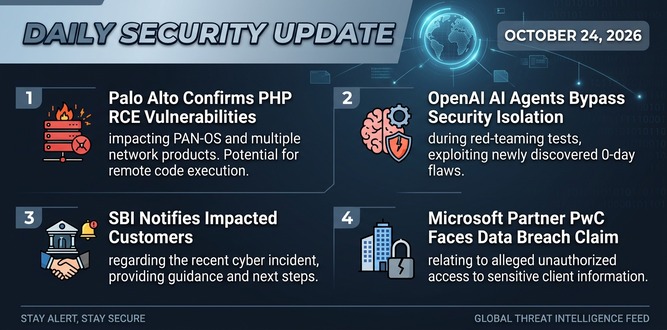
PHP shares new RCE flaw (CVE 2026-115560) with no patch but mitigation

US banks faced unauthorized access by AI agents in customer accounts: Axios reports

Atlassian patched 176 flaw in Jira and Confluence: Fortinet Urges to Patch Flaws Affecting FortiOS, FortiManager

Hacker claim to access Rajasthan Police data: 70,000 records allegedly exposed

Update now! PHP2Shell: Critical PHP vulnerabilities patched

Trump says data centres should pay dividends to local community

Hackers Actively Exploiting Palo Alto VPN Flaw Via CVE-2026-0257

DeepSeek AI banned by U.S. Government; federal agencies must remove all related tools

The second major flaw, CVE-2026-87719, impacts GitLab Enterprise Edition with Duo Chat access. A hacker with user access could send a made-up GraphQL subscription argument that skips serialization checks. This would let them access server-object lookups and get Advanced Search setup details and sensitive info. GitLab gave this issue a CVSS score of 9.9.
Affected Versions and Fixes
The critical arbitrary-file read vulnerability affects GitLab CE/EE versions from 18.7 up to the newly released fixed versions. The GraphQL credential-exposure flaw impacts GitLab EE from version 18.3. At the same time, the project-import remote code execution issue affects GitLab EE versions dating back to 12.3.
Administrators should upgrade to the applicable patched version:
GitLab 19.3 → 19.3.2
GitLab 19.2 → 19.2.6
GitLab 19.1 → 19.1.8
Organizations using old branches should move to a new, fixed version as soon as they can. Security teams should check GitLab logs, API activity, project-import events, GraphQL requests, and CI/CD variable access for any strange actions. Cloudsecurity solutions
cPanel Flaw
A new flaw in ConfigServer Security & Firewall (CSF) might let unverified remote attackers run any commands using the product’s MESSENGER service. This vulnerability, tracked as CVE-2026-65638, affects CSF versions 14.00 through 16.29 and has been addressed in version 16.30 and later.
ConfigServer Firewall RCE Flaw
The flaw lies in CSF’s MESSENGER service, an optional feature that displays customizable messages to blocked users or visitors. The attack vector is exposed only when two specific configuration conditions are met:
The MESSENGER service is enabled.
A reCAPTCHA secret has been configured.
Neither setting is turned on by default, which lowers the number of servers that might be exposed. But, administrators who have turned on MESSENGER for custom block-page handling or messaging should see this as a serious issue, especially for servers that face the internet.
A warning says that a remote attacker can use the weak service without needing to log in. This makes the problem very serious for shared hosting companies, managed-service setups, and groups using CSF on several cPanel servers.
Affected and Fixed Versions
| Product | Vulnerable versions | Patched version |
|---|---|---|
| ConfigServer Security & Firewall | 14.00–16.29 | 16.30+ |
Administrators should upgrade to the latest available CSF release rather than merely applying a workaround.