 InfoSecBulletin Cybersecurity for mankind

LockBit is back in the headlines as one of its sub-groups claimed to have attacked the world’s largest chip maker – TSMC. It has asked for a hefty ransom, the refusal of which would lead to the publishing of stolen data. Speaking of ransomware attacks, the University of Manchester breach also impacted over a million NHS patients, including records of patients who have suffered major trauma. Moving on to another critical news, researchers have recorded a massive surge in the exploitation of remote servers. Without much ado, here’s everything you need to know from the last 24 hours.
- National Hazard Agency, a LockBit ransomware sub-group, claims to have hacked Taiwan Semiconductor Manufacturing Company (TSMC) and is demanding a ransom of $70 million. The deadline for payment is August 6.
- A ransomware attack on the University of Manchester compromised the NHS patient data set of 1.1 million patients across 200 hospitals. The information includes NHS numbers, records of trauma patients, and the first three letters of patients’ postcodes.
- The number of individuals impacted by hackers exploiting vulnerabilities in the MOVEit software has surpassed 16 million. This number is expected to rise significantly. Additionally, 158 organizations have disclosed falling victim to the exploitation of the flaw by the Cl0p ransomware gang.
- A threat group claiming affiliation with the Wagner Group launched a cyberattack on Russian satellite communications provider Dozor-Teleport. The group leaked 700 files, including documents and images, allegedly belonging to the company.
- MITRE has released a list of the top 25 most dangerous vulnerabilities in software. The list was created by analyzing 43,996 CVE entries from NIST’s National Vulnerability Database (NVD).
- The pro-Russian crowdsourced DDoS project, named DDoSia, experienced a massive 2,400% growth in less than a year. The project now has over 10,000 participants conducting attacks on Western organizations, according to Sekoia.
- MIT researchers developed the Metior framework that provides a quantitative assessment of cybersecurity obfuscation schemes. The framework can help engineers evaluate the effectiveness of different security approaches.
- A new report by ReliaQuest recorded almost 5,000 instances of remote server exploitation, including RDPs and VPNs. This makes it the most commonly used attack technique in 2022.
- Network assurance firm IP Fabric raised $25 million in a Series B funding round. The round was led by One Peak, with participation from Senovo and Presto Ventures.
- Israel-based application security platform Nokod Security announced a $8 million seed-stage funding round. The round was led by Acrew Capital, with investment from Meron Capital and Flint Capital.
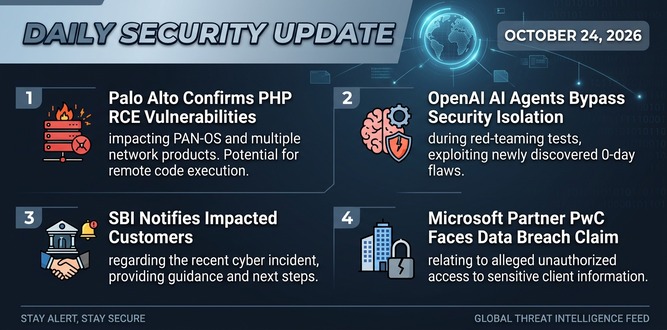
Daily Cyber security update for 24. 10. 2026
By infosecbulletin
/ Saturday , October 24 2026
Cyberattacks are rising around the world, including ransomware, malware, data leaks, and hacked websites. These events show how complex and...
Read More
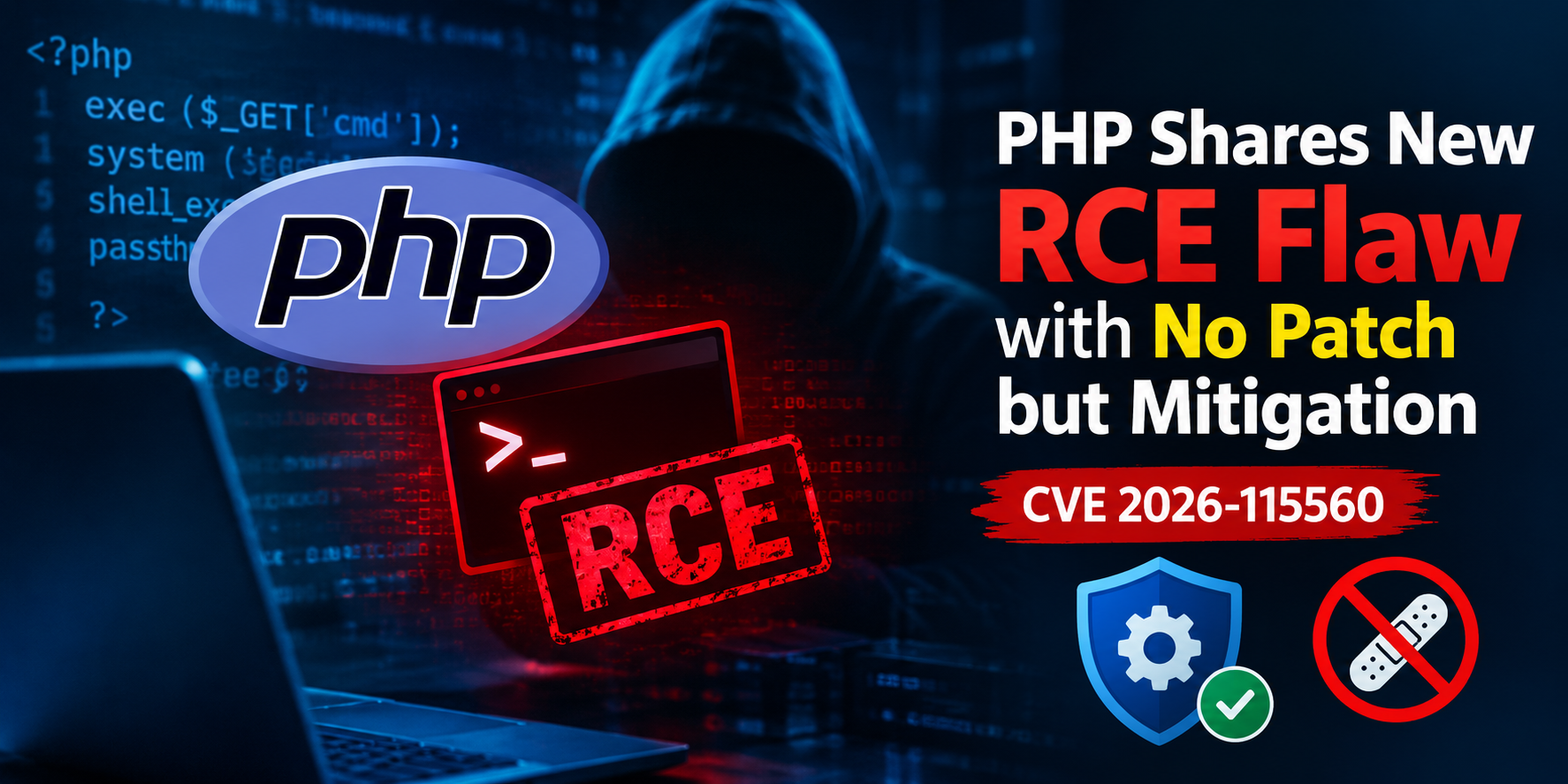
PHP shares new RCE flaw (CVE 2026-115560) with no patch but mitigation
By infosecbulletin
/ Friday , October 23 2026
The PHP security team shared ways to protect against a new flaw that lets someone run unwanted code on certain...
Read More
US banks faced unauthorized access by AI agents in customer accounts: Axios reports
By infosecbulletin
/ Friday , October 23 2026
Major US banks have detected unauthorized access to customer accounts by third-party AI agents, with some systems taking actions beyond...
Read More

Atlassian patched 176 flaw in Jira and Confluence: Fortinet Urges to Patch Flaws Affecting FortiOS, FortiManager
By infosecbulletin
/ Thursday , October 22 2026
Fortinet has urged customers to prioritize security updates for FortiOS, FortiManager, and FortiAnalyzer scheduled for October 22, 2026. The coordinated...
Read More

Hacker claim to access Rajasthan Police data: 70,000 records allegedly exposed
By infosecbulletin
/ Wednesday , October 21 2026
Hacker offers to sell Rajasthan Government’s Department of Information Technology & Communication (DoIT&C) data in a underground forum. The threat...
Read More
Update now! PHP2Shell: Critical PHP vulnerabilities patched
By infosecbulletin
/ Wednesday , October 21 2026
The PHP team released urgent security updates to fix PHP2Shell, two serious flaws (CVE-2026-109618 and CVE-2026-109619) that let attackers run...
Read More

Trump says data centres should pay dividends to local community
By infosecbulletin
/ Wednesday , October 21 2026
US President Donald Trump said on Wednesday that companies building data centers should pay a "dividend" to the communities where...
Read More

Hackers Actively Exploiting Palo Alto VPN Flaw Via CVE-2026-0257
By infosecbulletin
/ Tuesday , October 20 2026
Ransomware groups are using a flaw in Palo Alto Networks GlobalProtect VPN to get around multi-factor authentication and access corporate...
Read More

DeepSeek AI banned by U.S. Government; federal agencies must remove all related tools
By infosecbulletin
/ Tuesday , October 20 2026
The U.S. Department of Homeland Security (DHS) ordered federal agencies to stop using DeepSeek products and remove it from all...
Read More

CISA, NSA and NIST Publish New 10 AI Agent Control Guidelines
By infosecbulletin
/ Monday , October 19 2026
NSA, CISA, and NIST have released security guidelines to find, control, and stop AI agents that go beyond their allowed...
Read More