 InfoSecBulletin Cybersecurity for mankind

Google’s Threat Intelligence Group found Coruna, a complex iOS exploit kit with 23 exploits in five chains, affecting thousands of iPhones on iOS 13.0 to 17.2.1 in 2025. The Coruna exploit kit is a sophisticated iOS attack tool by GTIG that targets iPhones from iOS 13.0 (September 2019) to iOS 17.2.1 (December 2023).
“A highly sophisticated set of iPhone hijacking techniques has likely infected tens of thousands of phones or more. Clues suggest it was originally built for the US government” according to Wired.
Hacker stole Meta GitHub repos; Stole Source Code

Urgent patch! Zoom,NVIDIA and IBM Patch 41 Security flaws

Microsoft patches record braking 1411 flaws; 2 zero days

Anthropic unveils “OSS Scanner” Free AI Vulnerability Scanner for Open-Source Projects

Rise on RCE Exploits Targeting Hikvision Camera Flaw

FortiBleed Attack Compromised 80,000+ Devices, SonicWall Patches 4 SMA1000 Flaws CVSS 10

Critical Atlassian & IBM Flaws Expose Files and Enable Remote Code Execution

Citrix NetScaler SAML 0-Day Flaw Under Attack

Major Danish university breached, 200,000 users at risk

Microsoft’s X account hijacked to promote Clippy crypto scam

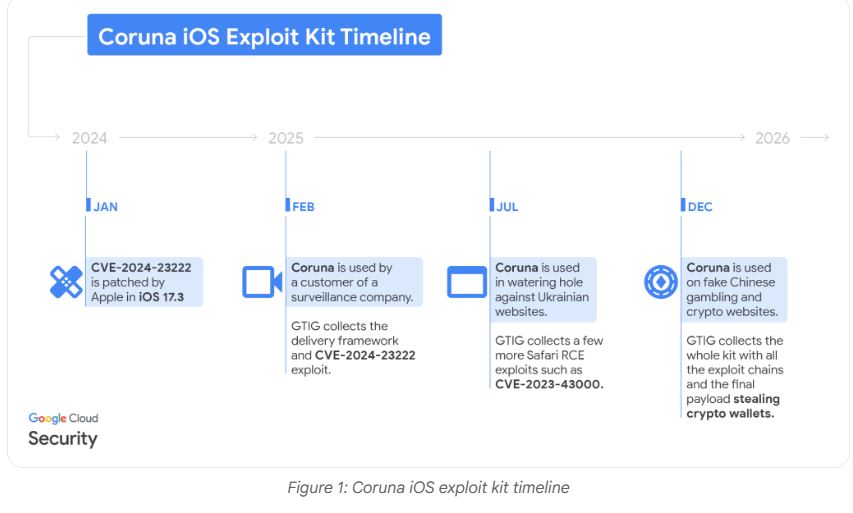
Three-Phase Exploit Timeline:
GTIG observed Coruna moving through three different groups of threat actors over the course of 2025, a rare window into how elite exploit kits proliferate from commercial surveillance vendors to state-sponsored espionage groups and finally to financially motivated criminals.
February 2025 – Commercial Surveillance Customer: GTIG discovered an iOS exploit chain using a new JavaScript framework with unique obfuscation. This framework identified the iPhone model and iOS version before executing a WebKit remote code execution (RCE) exploit and bypassing Pointer Authentication Code (PAC).
Summer 2025 – Russian Espionage (UNC6353): A similar JavaScript framework was discovered on cdn.uacounter[.]com, hidden in iFrames on many compromised Ukrainian websites in various sectors. Attacks targeted iPhone users based on their geolocation. GTIG informed CERT-UA to address the affected sites.
Late 2025 – Chinese Financial Fraud (UNC6691): A full exploit kit was found within a network of fake Chinese financial and crypto websites targeting iOS users. One fake WEEX crypto exchange site even showed pop-ups encouraging users to visit on their iPhones.
The Exploits and Their Code Names
| Type | Codename | Targeted versions (inclusive) | Fixed version | CVE |
| WebContent R/W | buffout | 13 → 15.1.1 | 15.2 | CVE-2021-30952 |
| WebContent R/W | jacurutu | 15.2 → 15.5 | 15.6 | CVE-2022-48503 |
| WebContent R/W | bluebird | 15.6 → 16.1.2 | 16.2 | No CVE |
| WebContent R/W | terrorbird | 16.2 → 16.5.1 | 16.6 | CVE-2023-43000 |
| WebContent R/W | cassowary | 16.6 → 17.2.1 | 16.7.5, 17.3 | CVE-2024-23222 |
| WebContent PAC bypass | breezy | 13 → 14.x | ? | No CVE |
| WebContent PAC bypass | breezy15 | 15 → 16.2 | ? | No CVE |
| WebContent PAC bypass | seedbell | 16.3 → 16.5.1 | ? | No CVE |
| WebContent PAC bypass | seedbell_16_6 | 16.6 → 16.7.12 | ? | No CVE |
| WebContent PAC bypass | seedbell_17 | 17 → 17.2.1 | ? | No CVE |
| WebContent sandbox escape | IronLoader | 16.0 → 16.3.116.4.0 (<= A12) | 15.7.8, 16.5 | CVE-2023-32409 |
| WebContent sandbox escape | NeuronLoader | 16.4.0 → 16.6.1 (A13-A16) | 17.0 | No CVE |
| PE | Neutron | 13.X | 14.2 | CVE-2020-27932 |
| PE (infoleak) | Dynamo | 13.X | 14.2 | CVE-2020-27950 |
| PE | Pendulum | 14 → 14.4.x | 14.7 | No CVE |
| PE | Photon | 14.5 → 15.7.6 | 15.7.7, 16.5.1 | CVE-2023-32434 |
| PE | Parallax | 16.4 → 16.7 | 17.0 | CVE-2023-41974 |
| PE | Gruber | 15.2 → 17.2.1 | 16.7.6, 17.3 | No CVE |
| PPL Bypass | Quark | 13.X | 14.5 | No CVE |
| PPL Bypass | Gallium | 14.x | 15.7.8, 16.6 | CVE-2023-38606 |
| PPL Bypass | Carbone | 15.0 → 16.7.6 | 17.0 | No CVE |
| PPL Bypass | Sparrow | 17.0 → 17.3 | 16.7.6, 17.4 | CVE-2024-23225 |
| PPL Bypass | Rocket | 17.1 → 17.4 | 16.7.8, 17.5 | CVE-2024-23296 |