Tuesday , June 23 2026
zero-day

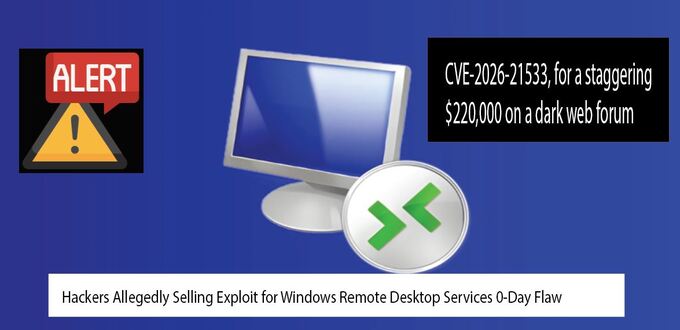
Hackers Allegedly Selling Exploit for Windows RDS 0-Day Flaw

A hacker is reportedly selling a zero-day exploit for a Windows Remote Desktop Services vulnerability, CVE-2026-21533, for $220,000 on the dark web. This exploit takes advantage of poor privilege management to give attackers local admin access.

A new user, Kamirmassabi, is auctioning an exploit for CVE-2026-21533 on a dark web forum. CVE-2026-21533 is a severe Elevation of Privilege (EoP) vulnerability rooted in improper privilege management within Windows Remote Desktop.

New Apple Exploit Bypasses Boot Defenses, Possibly Affects Millions of iPhones Worldwide

Researchers at cybersecurity firm Paradigm Shift found a new flaw called usbliter8. This flaw can get around main boot protections...
Read More
New Apple Exploit Bypasses Boot Defenses, Possibly Affects Millions of iPhones Worldwide

India’s Tata Electronics hit by cyber breach: Hacker target 630 GB record

A cyber attack seems to have affected one of India's top electronics companies. Tata Electronics has said there was a...
Read More
India’s Tata Electronics hit by cyber breach: Hacker target 630 GB record

Anthropic’s Mythos reportedly broke NSA classified systems in hours

The recent finding shows how powerful Mythos is: the AI can access the US government's secret networks in just a...
Read More
Anthropic’s Mythos reportedly broke NSA classified systems in hours

OpenAI New Method “Deployment Simulation” Predicts AI Risks Before Deployment

Test before going live is important for AI developers. But there's a problem: testing usually uses fake scenarios that often...
Read More
OpenAI New Method “Deployment Simulation” Predicts AI Risks Before Deployment

AryStinger botnet infected thousands of D-Link routers globally

AryStinger has taken control of over 4,000 old D-Link routers to use them as proxies for harmful traffic. The team...
Read More
AryStinger botnet infected thousands of D-Link routers globally

Hacker suspected of sending alerts across Brazil

Brazil's government suspects a hacking attack triggered an unauthorized ‌alert sent to cell phones across parts of the country early...
Read More
Hacker suspected of sending alerts across Brazil

CyberSentinel AI features 33 security tools like Nmap, SQLMap, and ZAP, utilizing Claude and GPT

A new open-source cybersecurity tool named CyberSentinel AI v3.0 has come out. It is an important step in self-operated security...
Read More
CyberSentinel AI features 33 security tools like Nmap, SQLMap, and ZAP, utilizing Claude and GPT

Barracuda hosts Dhaka roundtable on cyber resilience

Barracuda gathered industry people in Dhaka on 18 June 2026 for a roundtable talk about cyber resilience. The company shared...
Read More
Barracuda hosts Dhaka roundtable on cyber resilience

CISA Alerts Fortinet Users as FortiBleed Affects 86,644 FortiGate Devices

The U.S. Cybersecurity and Infrastructure Security Agency (CISA) asked Fortinet users with FortiGate devices on Thursday to act to protect...
Read More
CISA Alerts Fortinet Users as FortiBleed Affects 86,644 FortiGate Devices

CISA: Splunk flaw under active exploit, patch by Sunday

The U.S. Cybersecurity and Infrastructure Security Agency (CISA) has asked federal agencies to protect their systems by Sunday from a...
Read More
CISA: Splunk flaw under active exploit, patch by Sunday

The threat actor, who created their account on March 3, 2026, posted the listing in the “[Virology] – malware, exploits, bundles, AZ, crypt” section.
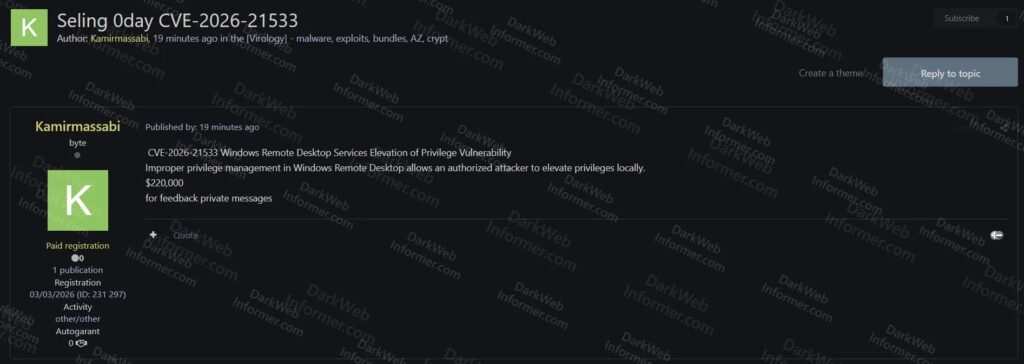
                         Windows Remote Desktop Services 0-Day Claim (Source: Dark Web Informer)

This vulnerability impacts a vast array of Microsoft operating systems, including various builds of Windows 10, Windows 11, and Windows Server editions ranging from 2012 to the latest 2025 releases.

The vulnerability has a CVSSv3 score of 7.8, categorizing it as high severity. Its inclusion in the CISA Known Exploited Vulnerabilities list highlights the urgent need for fixing it.

Organizations should quickly apply the latest Microsoft security patches to all affected systems and servers. If unable to implement these patches right away, administrators should refer to CISA BOD 22-01 guidance for cloud services or disable Remote Desktop Services.

Administrators should disable RDS if not strictly necessary, restrict access to trusted networks, and deploy Endpoint Detection and Response (EDR) solutions to monitor for anomalous registry changes and privilege escalation attempts.


Check Also

CISA

CISA: Splunk flaw under active exploit, patch by Sunday

The U.S. Cybersecurity and Infrastructure Security Agency (CISA) has asked federal agencies to protect their …