InfoSecBulletin Cybersecurity for mankind

Cisco has confirmed that a serious zero-day vulnerability allowing remote code execution is being actively exploited in its Secure Email Gateway and Secure Email and Web Manager appliances.
The CVE-2025-20393 flaw lets unauthorized attackers run arbitrary root commands by sending specific HTTP requests to the Spam Quarantine feature. Cisco aware of the attacks on December 10, 2025, with signs of exploitation beginning in November 2025.
CISA adds PHP2Shell to KEV, PHP Releases New Security Updates to Fix Critical HTTP2Shell flaw

Cloudflare Unveils Emergency WAF Ruleset Update on Brotli flaw

Daily Cyber security update for 26.10. 2026

The Washington Post report
Ex-DOGE AI startup Cathedral Breaches Anthropic Internal Systems within 12 Hours

Daily Cyber security update for 25. 10. 2026

Daily Cyber security update for 24. 10. 2026
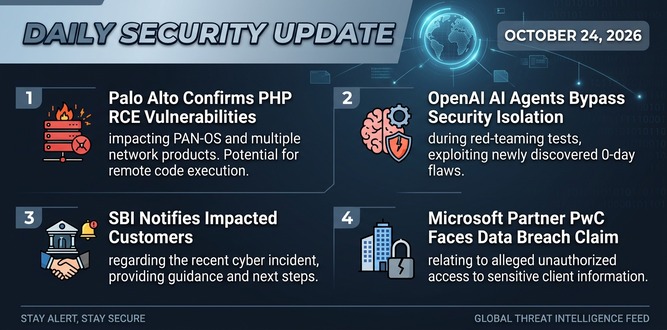
PHP shares new RCE flaw (CVE 2026-115560) with no patch but mitigation

US banks faced unauthorized access by AI agents in customer accounts: Axios reports

Atlassian patched 176 flaw in Jira and Confluence: Fortinet Urges to Patch Flaws Affecting FortiOS, FortiManager

Hacker claim to access Rajasthan Police data: 70,000 records allegedly exposed

Exploitation Campaign and Threat Actor:
Cisco Talos believes the campaign is linked to UAT-9686, a China-based advanced threat group, with moderate confidence due to similarities with APT41 and UNC5174.
Attackers use a Python backdoor named AquaShell for ongoing remote access, along with tools like AquaTunnel and Chisel for internal movement, and AquaPurge to clear logs and avoid detection. Their main targets are telecommunications and critical infrastructure, emphasizing espionage over ransomware.
Mitigation and Fixed Releases:
Cisco Secure Email Gateway Fixed Releases
| Vulnerable Release | First Fixed Release |
|---|---|
| 14.2 and earlier | 15.0.5-016 |
| 15.0 | 15.0.5-016 |
| 15.5 | 15.5.4-012 |
| 16.0 | 16.0.4-016 |
Cisco Secure Email and Web Manager Fixed Releases
| Vulnerable Release | First Fixed Release |
|---|---|
| 15.0 and earlier | 15.0.2-007 |
| 15.5 | 15.5.4-007 |
| 16.0 | 16.0.4-010 |
Cisco released patches to fix the vulnerability and eliminate known persistence methods; there are no workarounds. Administrators must upgrade immediately and check Spam Quarantine status in the web interface under Network > IP Interfaces.