InfoSecBulletin Cybersecurity for mankind

Check Point data reveals a 60% increase in ransomware attacks, with North America and Europe being the primary targets. The rise in enterprise Gen AI use has also exposed sensitive data. In 2025, ransomware attacks stood out for their volume, scale, and damage.
The December 2025 Global Cyber Attack Statistics from Check Point show that organizations faced an average of 2,027 attacks per week, a 9% increase from December 2024. In the UK alone, each organization suffered 1,440 cyber attacks per week, a rise of 39%.
Daily Cyber security update for 25. 10. 2026

Daily Cyber security update for 24. 10. 2026
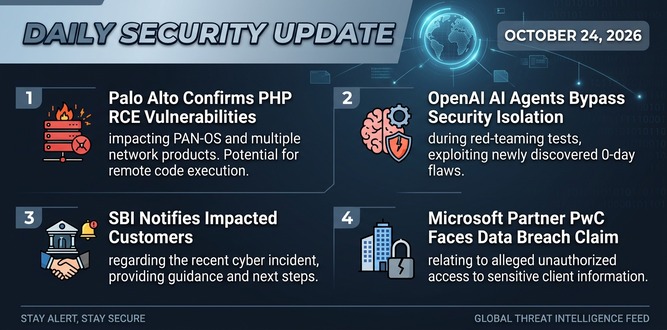
PHP shares new RCE flaw (CVE 2026-115560) with no patch but mitigation

US banks faced unauthorized access by AI agents in customer accounts: Axios reports

Atlassian patched 176 flaw in Jira and Confluence: Fortinet Urges to Patch Flaws Affecting FortiOS, FortiManager

Hacker claim to access Rajasthan Police data: 70,000 records allegedly exposed
Update now! PHP2Shell: Critical PHP vulnerabilities patched

Trump says data centres should pay dividends to local community

Hackers Actively Exploiting Palo Alto VPN Flaw Via CVE-2026-0257

DeepSeek AI banned by U.S. Government; federal agencies must remove all related tools

“December’s data shows that cyber risk is no longer about isolated spikes, but continuous pressure,” says Mark Weir, Regional Director, UK and Ireland at Check Point Software.
“Ransomware continues to scale through industrialised operations, while unmanaged Gen AI usage is creating widespread data exposure at the enterprise level.
“Moving into 2026, organisations must prioritise prevention-first security, real-time AI threat intelligence and strong governance over how AI tools are used across the business.”
Qilin the major culprit:
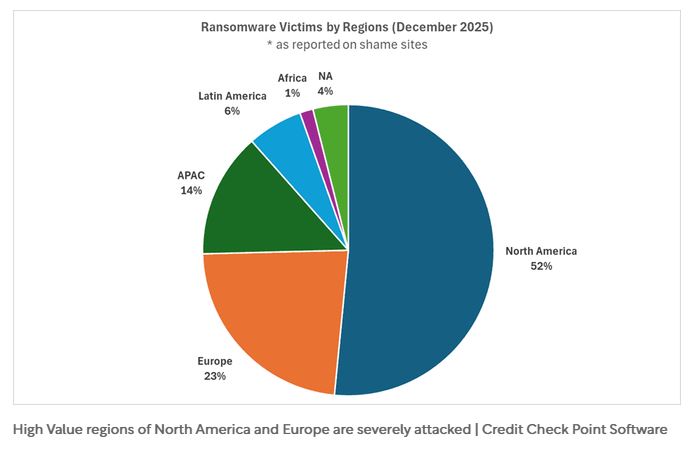
December 2025 had 945 reported ransomware incidents, up 60% from December 2024. Check Point’s report reveals that over half (52%) of ransomware incidents happened in North America, while Europe accounted for 23%. This highlights cybercriminals’ focus on valuable areas.
A Russian cybercrime group called Qilin, which provides Ransomware-as-a-Service, was the most active in December. They were responsible for 18% of publicly reported ransomware attacks.
RaaS cybercrime groups LockBit5 and Akira were major players, responsible for 12% and 7% of cyber attacks, respectively. Ransomware groups continue to target Windows, Linux, and ESXi virtual environments, according to the report.
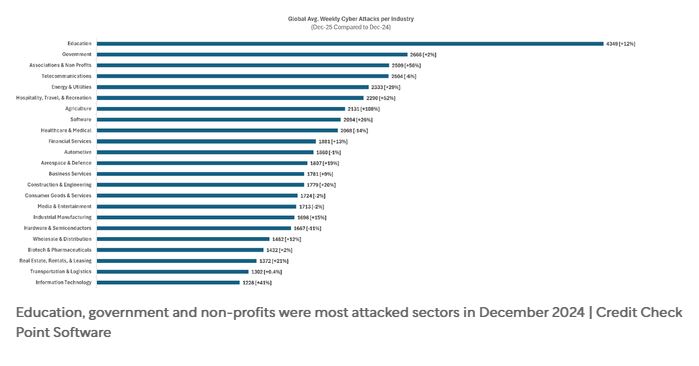
Education, government and non-profits the main targets:
Check Point’s data shows education faced the highest number of cyber attacks globally, averaging 4,349 per week. Government institutions experienced 2,666 attacks weekly, while non-profit organizations faced an average of 2,509 attacks.
Aging infrastructure and resource shortages make enterprises vulnerable to cyber attacks, and a new threat called Gen AI is increasing this risk.
Quickly used and trusted to enhance productivity, data shows that an average of 11 different Gen AI tools are used by employees, creating massive enterprise security flaws.
“Even as AI tools drive unprecedented productivity, we are simultaneously stepping backward in security because organisations are integrating them faster than they secure them,” says Nataly Kremer, Chief Product Officer (CPO) at Check Point Software Technologies.
“At Check Point Software Point, we see this first hand. In just one month, our teams identified about ten significant vulnerabilities across widely used AI tools.”
Check Point’s research indicates that one in every 27 Gen AI prompts from company networks risks leaking sensitive data. The report shows that most organisations using Gen AI tools face high-risk prompt activity.
As one in four (25%) prompts may expose sensitive information, the rise of unofficial AI use by employees significantly raises the chance of companies experiencing AI-related cyber attacks.