 InfoSecBulletin Cybersecurity for mankind

Google’s Threat Intelligence Group, Mandiant, and their partners disrupted a global espionage campaign linked to a suspected Chinese threat actor UNC2814. This group used SaaS API calls to disguise malicious traffic in attacks against telecom and government networks.
The campaign has been ongoing since 2023 and has affected 53 organizations across 42 countries, with potential infections in at least 20 additional countries.
Hacker claim to access Rajasthan Police data: 70,000 records allegedly exposed

Update now! PHP2Shell: Critical PHP vulnerabilities patched

Trump says data centres should pay dividends to local community

Hackers Actively Exploiting Palo Alto VPN Flaw Via CVE-2026-0257

DeepSeek AI banned by U.S. Government; federal agencies must remove all related tools

CISA, NSA and NIST Publish New 10 AI Agent Control Guidelines
Claude AI Cracks 25-Year NSA Cryptography Number Mystery in Just 30 Minutes

Bypassing firewalls, AI Agents Accessed Indian ‘ Data Without Permission: CERT-In

MITRE ATT&CK v20 Unveils 9 New Attack Techniques On AI Exploits, MFA Bypass, and CAPTCHA Evasion

Hackers Exploit Fortinet Flaws to Deploy Stealthy PEERSTITCH Malware on FortiGate Firewalls

Google reports that a disrupted campaign used a new C-based backdoor called ‘GRIDTIDE,’ which exploits the Google Sheets API for stealthy command-and-control (C2) operations.
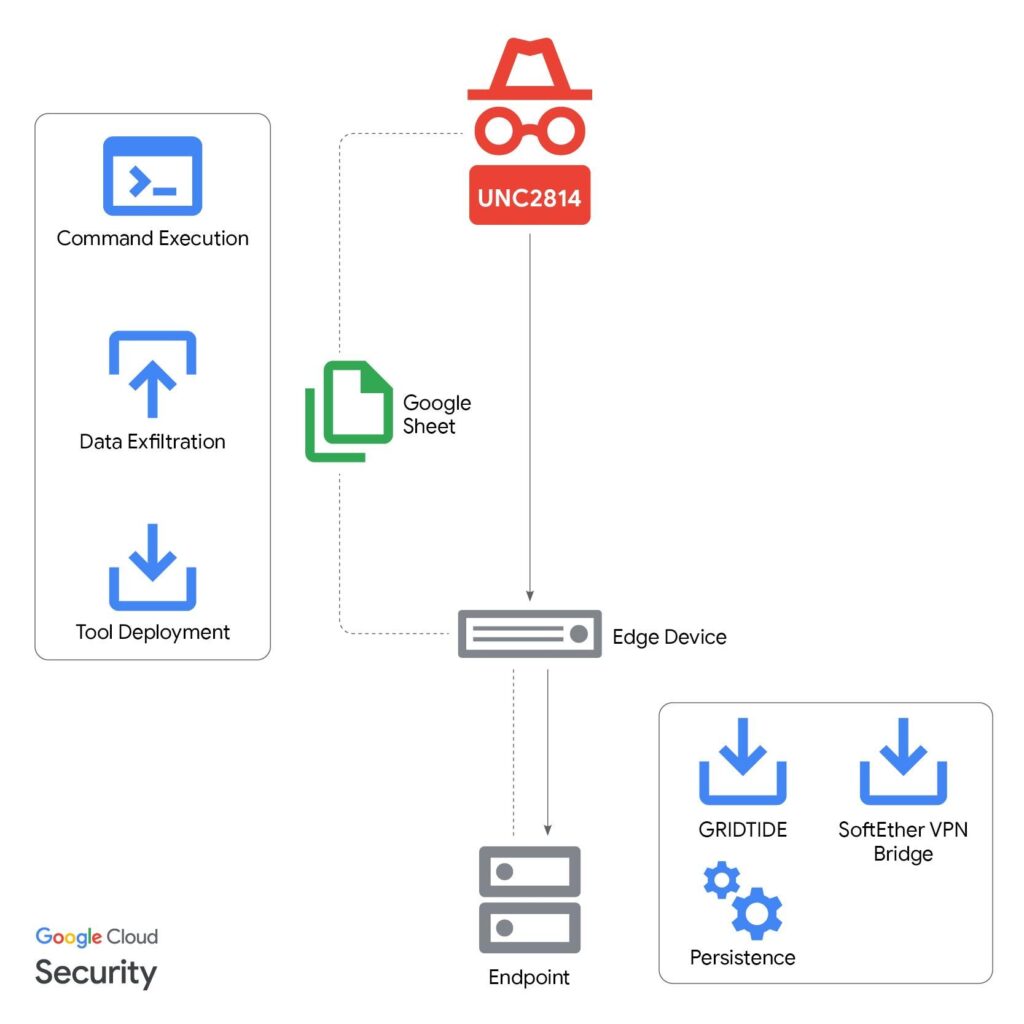
GRIDTIDE authenticates to a Google Service Account using a hardcoded private key, and upon launch, it sanitizes the spreadsheet by deleting rows 1-1000 and columns from A to Z.
It collects host information like username, hostname, OS, local IP, locale, and time zone, and logs it in cell V1. The first cell in the spreadsheet, A1, is the command/status cell, which GRIDTIDE polls constantly to receive instructions.
The malware overwrites any existing status strings. If there are none, it attempts to check every second for 120 times before switching to random checks every 5-10 minutes to minimize detection.
Google states that GRIDTIDE’s communication with the C2 uses a URL-safe base64 encoding, making it hard for web monitoring tools to detect and allowing it to blend with regular traffic.
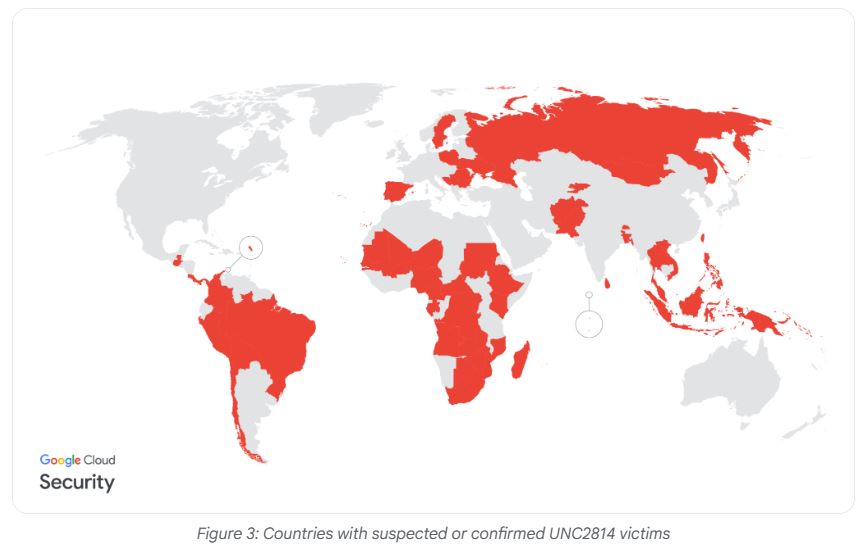
The countries with suspected or confirmed victims of UNC2814 in Mandiant’s report shown that Bangladesh is among the victim lists. So, it indicates that the threat actor may have breached (suspected) Gov.t and telecom sector of Bangladesh for a long time to exfiltrated data.
GTIG confirmed 53 intrusions by UNC2814 in 42 total nations globally and identified suspected targeting in at least 20 other nations. Google said, this prolific scope is likely the result of a decade of concentrated effort.