InfoSecBulletin Cybersecurity for mankind

A simple Python script to help organizations quickly detect exposure to CVE-2025-20393, a critical zero-day vulnerability in Cisco Secure Email Gateway (SEG) and Secure Malware Analytics (SMA).
The “Cisco SMA Exposure Check” tool identifies open ports and services exploited in recent attacks, as noted in Cisco’s advisory.
Apple iOS 27.2 Released Fixes 163 Flaws, Including Critical WebKit RCE

CISA adds PHP2Shell to KEV, PHP Releases New Security Updates to Fix Critical HTTP2Shell flaw

Cloudflare Unveils Emergency WAF Ruleset Update on Brotli flaw

Daily Cyber security update for 26.10. 2026

The Washington Post report
Ex-DOGE AI startup Cathedral Breaches Anthropic Internal Systems within 12 Hours

Daily Cyber security update for 25. 10. 2026

Daily Cyber security update for 24. 10. 2026
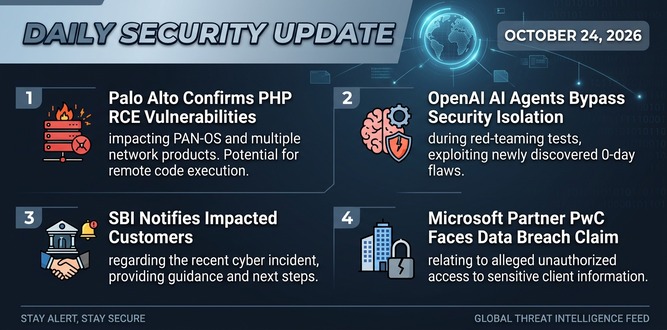
PHP shares new RCE flaw (CVE 2026-115560) with no patch but mitigation

US banks faced unauthorized access by AI agents in customer accounts: Axios reports

Atlassian patched 176 flaw in Jira and Confluence: Fortinet Urges to Patch Flaws Affecting FortiOS, FortiManager

GitHub user StasonJatham released a script today that identifies indicators of compromise related to a vulnerability. This flaw lets unauthorized remote attackers run arbitrary code through exposed management and quarantine interfaces.
Attackers are exploiting ports such as TCP 82, 83, 443, 8080, 8443, and 9443 for admin access, and targeting quarantine endpoints on 6025, 82, 83, 8443, and 9443.
The tool scans and identifies HTTP/S signatures by examining server headers, status codes, redirects, authentication realms, Cisco keywords, and version patterns. It also checks common paths like /quarantine, /spamquarantine, /spam, /sma-login, and /login.
It also grabs raw socket banners and flags indicators of active exploitation, including strings like “AquaShell,” “AquaTunnel,” “Chisel,” and “AquaPurge” – hallmarks of post-compromise tools observed in the wild.
The script, using only Python 3’s standard library, executes in seconds.
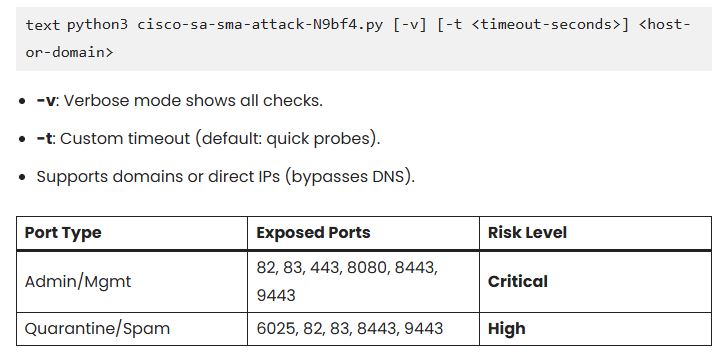
Results highlight vulnerable configurations, allowing admins to urgently firewall ports, apply Cisco patches, or isolate systems.
Cisco warns of active exploitation and urges immediate action. No CVSS score is available, but the vulnerability could lead to unauthenticated remote code execution, similar to previous SMA issues.