 InfoSecBulletin Cybersecurity for mankind

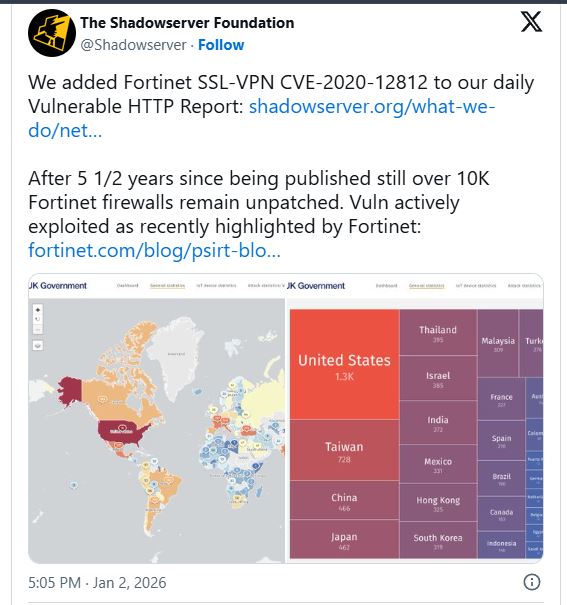
Over 10,000 Fortinet firewalls globally are still vulnerable to CVE-2020-12812, a flaw that allows bypassing multi-factor authentication (MFA) and was revealed over five years ago. Shadowserver added this issue to its daily Vulnerable HTTP Report.
CVE-2020-12812 is due to inadequate authentication in FortiOS SSL VPN portals, impacting versions 6.4.0, 6.2.0 to 6.2.3, and 6.0.9 or earlier. Attackers can bypass the second authentication factor, typically FortiToken, by simply altering the case of a legitimate username, such as changing “user” to “User,” during login.
Daily Cyber security update for 25. 10. 2026

Daily Cyber security update for 24. 10. 2026
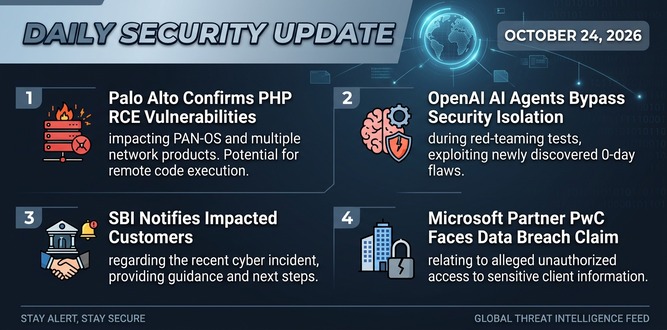
PHP shares new RCE flaw (CVE 2026-115560) with no patch but mitigation

US banks faced unauthorized access by AI agents in customer accounts: Axios reports

Atlassian patched 176 flaw in Jira and Confluence: Fortinet Urges to Patch Flaws Affecting FortiOS, FortiManager

Hacker claim to access Rajasthan Police data: 70,000 records allegedly exposed

Update now! PHP2Shell: Critical PHP vulnerabilities patched

Trump says data centres should pay dividends to local community

Hackers Actively Exploiting Palo Alto VPN Flaw Via CVE-2026-0257

DeepSeek AI banned by U.S. Government; federal agencies must remove all related tools

This happens because FortiGate treats local usernames as case-sensitive, while LDAP servers (like Active Directory) often ignore case, allowing authentication via group membership without prompting for MFA.
In December 2025, Fortinet issued a PSIRT advisory (FG-IR-19-283 update) detailing “recent abuse” of the vulnerability in the wild, tied to specific configurations: local FortiGate users with MFA enabled, linked to LDAP, and belonging to LDAP groups mapped to authentication policies for SSL VPN, IPsec, or admin access.
Shadowserver’s scans show the flaw is still present as scan on 2025-12-31. Shadowserver’s dashboard shows more than 10,000 vulnerable instances as of early January 2026. The U.S. has the most with 1.3K exposed firewalls, followed by Thailand (909), Taiwan (728), Japan (462), and China (462).
A world map visualization highlights dense clusters in North America, East Asia, and Europe, with lighter exposure in Africa and parts of South America.
Fortinet advises upgrading to FortiOS versions 6.0.10+, 6.2.4+, or 6.4.1+ and checking configurations to prevent hybrid local-LDAP MFA issues.