InfoSecBulletin Cybersecurity for mankind

A series of four security flaws found in OpenClaw, a rapidly growing open-source platform for self-operating AI agents, has put about 245,000 public server instances at risk of being hacked, having credentials stolen, and being installed with secret backdoors.
Originally started as “Clawdbot” in late 2025, OpenClaw links big language models to files, SaaS apps, user accounts, and working environments.
Apple iOS 27.2 Released Fixes 163 Flaws, Including Critical WebKit RCE

CISA adds PHP2Shell to KEV, PHP Releases New Security Updates to Fix Critical HTTP2Shell flaw

Cloudflare Unveils Emergency WAF Ruleset Update on Brotli flaw

Daily Cyber security update for 26.10. 2026

The Washington Post report
Ex-DOGE AI startup Cathedral Breaches Anthropic Internal Systems within 12 Hours

Daily Cyber security update for 25. 10. 2026

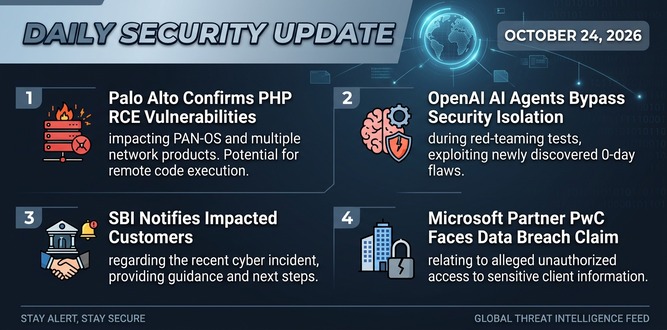
Daily Cyber security update for 24. 10. 2026
PHP shares new RCE flaw (CVE 2026-115560) with no patch but mitigation

US banks faced unauthorized access by AI agents in customer accounts: Axios reports

Atlassian patched 176 flaw in Jira and Confluence: Fortinet Urges to Patch Flaws Affecting FortiOS, FortiManager

Claw Chain OpenClaw Vulnerabilities
CVE-2026-44112 (CVSS 9.6 – Critical): A flaw in the OpenShell sandbox lets attackers change where data is written, which can allow them to alter settings and install hidden access on the host.
CVE-2026-44115 (CVSS 8.8 – High): A flaw in OpenClaw’s command checks and shell running lets environment variables — like API keys, tokens, and passwords — to escape through unquoted heredocs that seem safe during checks.
CVE-2026-44118 (CVSS 7.8 – High): OpenClaw trusts a flag from the client (senderIsOwner) without checking the user’s session. This lets a local process with a valid token gain owner-level control over the gateway setup, scheduling, and management.
CVE-2026-44113 (CVSS 7.7 – High): The same TOCTOU race condition pattern in read operations lets attackers swap validated file paths with symbolic links pointing outside the allowed mount root, exposing system files and internal artifacts the agent was never meant to access.
Shodan and ZoomEye scans from May 2026 show around 65,000 and 180,000 OpenClaw instances that anyone can access. This adds up to about 245,000 open servers.
Organizations using OpenClaw need to consider this as very important:
Patch immediately by applying the April 23, 2026, fixes covering GHSA-5h3g-6xhh-rg6p, GHSA-wppj-c6mr-83jj, GHSA-r6xh-pqhr-v4xh, and GHSA-x3h8-jrgh-p8jx.
Rotate all secrets — assume any environment variable or credential reachable by OpenClaw processes may already be compromised.
Identify exposed instances using Shodan scans or internal asset inventory and place them behind authentication or firewall controls.
Audit agent access and treat OpenClaw deployments as privileged identities subject to the same lifecycle controls as service accounts.