 InfoSecBulletin Cybersecurity for mankind

Fortinet customers are observing attackers exploiting a patch bypass for a previously fixed critical FortiGate authentication vulnerability (CVE-2025-59718) to hack patched firewalls.
One affected admins said that Fortinet has allegedly confirmed that the latest FortiOS version (7.4.10) didn’t fully address this authentication bypass vulnerability, which should’ve been patched in early December with the release of FortiOS 7.4.9.
Claude AI Cracks 25-Year NSA Cryptography Number Mystery in Just 30 Minutes

Bypassing firewalls, AI Agents Accessed Indian ‘ Data Without Permission: CERT-In
MITRE ATT&CK v20 Unveils 9 New Attack Techniques On AI Exploits, MFA Bypass, and CAPTCHA Evasion

Hackers Exploit Fortinet Flaws to Deploy Stealthy PEERSTITCH Malware on FortiGate Firewalls

Hacker stole Meta GitHub repos; Stole Source Code

Urgent patch! Zoom,NVIDIA and IBM Patch 41 Security flaws

Microsoft patches record braking 1411 flaws; 2 zero days
Anthropic unveils “OSS Scanner” Free AI Vulnerability Scanner for Open-Source Projects

Rise on RCE Exploits Targeting Hikvision Camera Flaw

FortiBleed Attack Compromised 80,000+ Devices, SonicWall Patches 4 SMA1000 Flaws CVSS 10

Fortinet is also reportedly planning to release FortiOS 7.4.11, 7.6.6, and 8.0.0 over the coming days to fully patch the security flaw.
“We just had a malicious SSO login on one of our FortiGate’s running on 7.4.9 (FGT60F). We have a SIEM that caught the local admin account being created. Now, I have done a little research, and it appears this is exactly how it looked when someone came in on CVE-2025-59718. But we have been on 7.4.9 since December 30th,” the admin said.
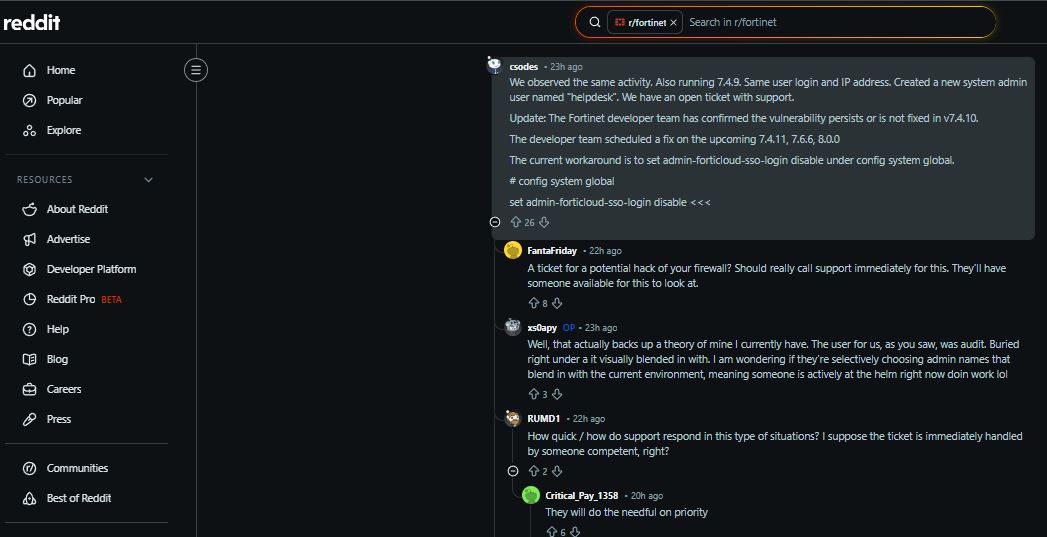
The customer shared logs showing that the admin user was created from an SSO login of [email protected] from IP address 104.28.244.114. These logs looked similar to previous exploitation of CVE-2025-59718 seen by cybersecurity company Arctic Wolf in December 2025, which reported that attackers were actively exploiting the vulnerability via maliciously crafted SAML messages to compromise admin accounts.
“We observed the same activity. Also running 7.4.9. Same user login and IP address. Created a new system admin user named “helpdesk”. We have an open ticket with support. Update: The Fortinet developer team has confirmed the vulnerability persists or is not fixed in v7.4.10,” another one added.
Admins should temporarily disable the vulnerable FortiCloud login feature until Fortinet releases a fully patched FortiOS.
To disable FortiCloud login, you have to navigate to System -> Settings and switch “Allow administrative login using FortiCloud SSO” to Off. However, you can also run the following commands from the command-line interface:

This prevents SSO-based attacks without disrupting local or SAML auth. Re-enable post-patch. Fortinet urges applying it now, especially for internet-exposed firewalls.
Audit Logs: Review for suspicious SSO logins and new admins (e.g., “helpdesk”).
Network Segmentation: Restrict admin access; enforce Local-In policies.
Monitoring: Integrate SIEM for admin changes; scan for IOCs like matching IPs/logins.
Patching: Upgrade to fixed versions upon release; test in staging.
Enterprise Response: If compromised, rotate credentials, isolate devices, and engage Fortinet support.
Luckily, as Fortinet explains in its original advisory, the FortiCloud single sign-on (SSO) feature targeted in the attacks is not enabled by default when the device is not FortiCare-registered, which should reduce the total number of vulnerable devices.
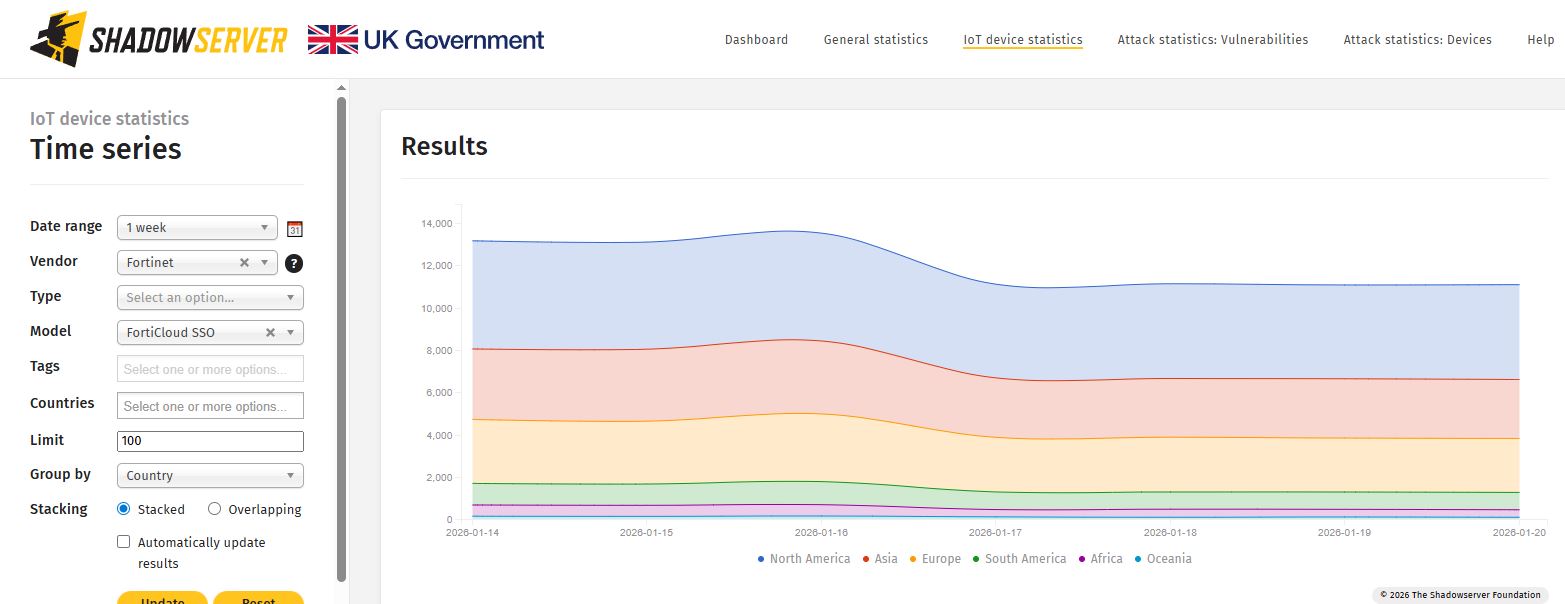
Shadowserver now tracking just over 11,000 that are still reachable over the Internet.