Cisco has updated its Identity Services Engine (ISE) to fix two critical security flaws that could let remote attackers execute arbitrary commands and gain elevated privileges on affected devices. The vulnerabilities are listed below: CVE-2025-20124 (CVSS score: 9.9): A vulnerability in a Cisco ISE API that allows an authenticated attacker …
Read More »Paragon spyware targeted victims in dozens of European countries: Italy says
WhatsApp revealed that seven Italians, along with victims from over a dozen other European countries, were targeted by spyware in a widespread hacking campaign, according to the Italian government. Italy’s cybersecurity agency, Agenzia per la Cybersicurezza Nazionale (ANC), is investigating alleged hacking attempts by Paragon Solutions, according to a statement …
Read More »Sophisticated malware attack on Indian Banks; Exposes 50,000 users
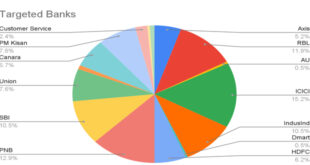
The zLabs research team found a mobile malware campaign with nearly 900 malware samples aimed at Indian bank users. Analysis shows shared code, interfaces, and logos, indicating a single group behind the attacks on Android devices. Zimperium’s detection engine successfully identified these as Trojan Bankers targeting Indian financial institutions. This …
Read More »CISA Adds 4 Actively Exploited Vuls to KEV Catalog
CISA added four security flaws to its Known Exploited Vulnerabilities (KEV) catalog, noting they are actively being exploited. The list of vulnerabilities is as follows: CVE-2024-45195 (CVSS score: 7.5/9.8) – (A vulnerability in Apache OFBiz that lets a remote attacker gain unauthorized access and run code on the server, fixed …
Read More »AMD Patches CPU Vulnerability
AMD announced patches on Monday for a microprocessor vulnerability that risks the loss of Secure Encrypted Virtualization (SEV) protection, potentially allowing attackers to load harmful microcode. CVE-2024-56161, with a CVSS score of 7.2, is a bug involving improper signature verification in the AMD CPU microcode patch loader’s read-only memory. The …
Read More »Hackers To Use HTTP Client Tools To Compromise Microsoft 365 Accounts
Hackers are using HTTP client tools for advanced account takeover attacks on Microsoft 365. Seventy-eight percent of Microsoft 365 tenants have been targeted by attacks, showing the changing tactics of threat actors. HTTP client tools are software that allows users to send HTTP requests and receive responses from web servers. …
Read More »Google patches 47 Android flaws, Including Actively Exploited CVE-2024-53104
Google has released patches for 47 security flaws in Android, including one that is actively being exploited. CVE-2024-53104 (CVSS score: 7.8) is a vulnerability that allows privilege escalation in the USB Video Class (UVC) driver kernel component. Successful exploitation of the flaw could lead to physical escalation of privilege, Google said, …
Read More »
CVE-2025-21415
Microsoft Patches Critical Azure AI Face Service Vulnerability
Microsoft has released patches for two critical security flaws in Azure AI Face Service and Microsoft Account that could allow an attacker to escalate their privileges. The flaws are listed below: CVE-2025-21396 (CVSS score: 7.5) – Microsoft Account Elevation of Privilege Vulnerability CVE-2025-21415 (CVSS score: 9.9) – Azure AI Face …
Read More »768 Exploited CVEs in 2024, a 20% Increase from 639 in 2023
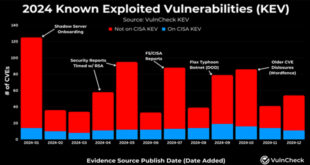
In 2024, 768 vulnerabilities with CVE identifiers were reported as exploited in the wild, a 20% increase from 639 in 2023. VulnCheck called 2024 “a strong year for threat actors exploiting vulnerabilities,” noting that 23.6% of known exploited vulnerabilities (KEVs) were weaponized by or on the day their CVEs were …
Read More ».Gov Domains Weaponized in Phishing Surge
A recent report from Cofense Intelligence highlights a concerning trend: threat actors are increasingly misusing .gov top-level domains (TLDs) to execute phishing campaigns. Between November 2022 and November 2024, attackers have leveraged vulnerabilities in government websites from various countries to host malicious content, act as command-and-control (C2) servers, and funnel …
Read More »
InfoSecBulletin Cybersecurity for mankind