InfoSecBulletin Cybersecurity for mankind

Zuckerberg announced that the company is constructing Gigawatt-Size Data Centers for its AI projects, with the first one launching next year.
“We’re calling the first one Prometheus and it’s coming online in ’26,” Zuckerberg wrote Monday in a post on his social platform Threads, referring to a project in Ohio. “We’re building multiple more titan clusters as well,” he added, a nod to other planned data center complexes.
Cloudflare Unveils Emergency WAF Ruleset Update on Brotli flaw

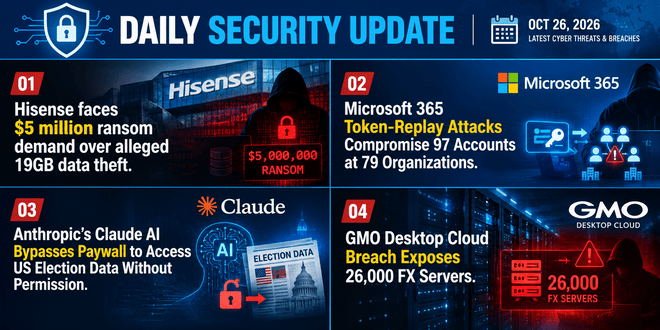
Daily Cyber security update for 26.10. 2026
The Washington Post report
Ex-DOGE AI startup Cathedral Breaches Anthropic Internal Systems within 12 Hours
Daily Cyber security update for 25. 10. 2026

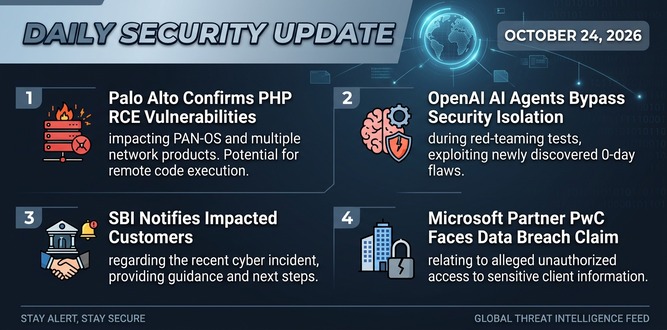
Daily Cyber security update for 24. 10. 2026
PHP shares new RCE flaw (CVE 2026-115560) with no patch but mitigation

US banks faced unauthorized access by AI agents in customer accounts: Axios reports

Atlassian patched 176 flaw in Jira and Confluence: Fortinet Urges to Patch Flaws Affecting FortiOS, FortiManager

Hacker claim to access Rajasthan Police data: 70,000 records allegedly exposed

Update now! PHP2Shell: Critical PHP vulnerabilities patched
In recent months, the CEO has gathered a team of experts to develop “superintelligence,” where machines could match or exceed human capabilities. This advancement in generative AI requires significant power, leading to a surge in building large data centers and acquiring costly chips from suppliers like Nvidia Corp.
Meta’s new Superintelligence Labs team consists of researchers from OpenAI, DeepMind, and other leading AI companies. Meta appointed Alexandr Wang, co-founder of Scale AI, as chief AI officer after investing $14.3 billion for a 49% stake in his company. Additionally, Zuckerberg recruited former GitHub CEO Nat Friedman, AI startup founder Daniel Gross, and Apple’s Ruoming Pang, who received a compensation package over $200 million, according to Bloomberg News.
Zuckerberg stated on Monday that the data centers being developed are large multigigawatt “clusters,” among the biggest globally. Meta is constructing its largest facility in Richland Parish, Louisiana, which is almost as big as Manhattan.
Most data centers today have hundreds of megawatts of capacity, but companies like OpenAI and Oracle Corp. plan to build facilities with several gigawatts, enough to power about 900,000 homes per year, according to Carbon Collective. This power scale is crucial for achieving superintelligence. Zuckerberg mentioned that Meta is set to be the first to create a “supercluster” with over a gigawatt of capacity, according to SemiAnalysis.
Massive data centers are straining local resources. The New York Times notes that Meta’s facilities in eastern Atlanta, Georgia, have depleted groundwater and are causing municipal water rates to rise by 33% in two years, with possible water rationing by 2030.
Public records from local water authorities reveal that Meta’s new facilities are seeking permits to consume up to 6 million gallons of water per day, surpassing the total daily usage of entire counties. “The data center is consuming the community’s wealth,” warned Mike Hopkins, water director for Newton County, Georgia. “We simply don’t have enough water.”
This is not an isolated issue. States including Texas, Arizona, Louisiana, and Colorado are all grappling with tightening water supplies due to the growing footprint of data center deployments. In some areas of Phoenix, Arizona, new housing projects have been halted entirely due to drought conditions and competition for limited resources.