InfoSecBulletin Cybersecurity for mankind
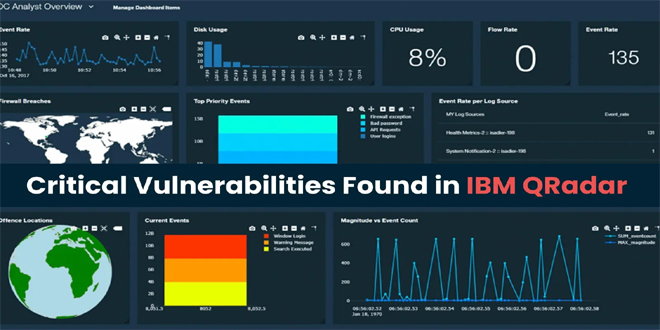
IBM has released a security bulletin about several vulnerabilities in its QRadar Suite Software. The company has fixed these vulnerabilities in the most recent software update.
IBM QRadar Suite Software is a cybersecurity platform that combines SIEM, SOAR, network traffic analysis, and vulnerability management. It helps in detecting threats, responding to incidents, and managing compliance.
Daily Cyber security update for 25. 10. 2026

Daily Cyber security update for 24. 10. 2026
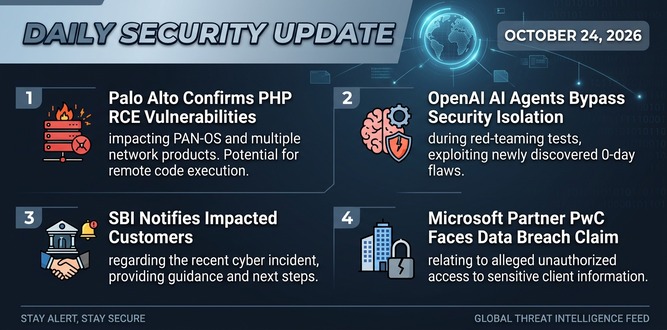
PHP shares new RCE flaw (CVE 2026-115560) with no patch but mitigation
US banks faced unauthorized access by AI agents in customer accounts: Axios reports

Atlassian patched 176 flaw in Jira and Confluence: Fortinet Urges to Patch Flaws Affecting FortiOS, FortiManager

Hacker claim to access Rajasthan Police data: 70,000 records allegedly exposed
Update now! PHP2Shell: Critical PHP vulnerabilities patched

Trump says data centres should pay dividends to local community

Hackers Actively Exploiting Palo Alto VPN Flaw Via CVE-2026-0257

DeepSeek AI banned by U.S. Government; federal agencies must remove all related tools

IBM’s QRadar Suite Software and IBM Cloud Pak for Security have vulnerabilities that attackers could exploit.
IBM Cloud Pak for Security: Versions 1.10.0.0 to 1.10.11.0
QRadar Suite Software: Versions 1.10.12.0 to 1.10.23.0
“CVE-2024-28799 IBM QRadar Suite Software 1.10.12.0 through 1.10.23.0 and IBM Cloud Pak for Security 1.10.0.0 through 1.10.11.0 displays sensitive data improperly during back-end com… https://t.co/QiOxOYFvXY
— CVE (@CVEnew) August 14, 2024″
Key Vulnerabilities Identified:
IBM report shows different types of vulnerabilities, including denial of service, cross-site scripting, mishandling of sensitive data, and potential arbitrary code execution. The report provides detailed descriptions and technical specifics for each vulnerability.
Node.js jose Module (CVE-2024-28176): This vulnerability involves a flaw during JWE Decryption operations that can be exploited to cause a denial of service.
“Node.js jose module is vulnerable to a denial of service, caused by a flaw during JWE Decryption operations. By sending a specially crafted request, a remote attacker could exploit this vulnerability to consume unreasonable amount of CPU time or memory, and results in a denial of service condition.’
Jinja Cross-Site Scripting (CVE-2024-34064): The vulnerability in the Jinja template engine allows for malicious attribute injection in web pages, potentially leading to authentication credential theft.
” A remote attacker could exploit this vulnerability to inject other attributes into a Web page which would be executed in a victims Web browser within the security context of the hosting Web site, once the page is viewed. “
idna Module Denial of Service (CVE-2024-3651): A local user can cause a system resource overload by exploiting the idna module using a tailored argument.
Plaintext Credential Storage (CVE-2024-25024): QRadar Suite stores user credentials in plaintext, making them vulnerable to unauthorized access by local users.
gRPC on Node.js Denial of Service (CVE-2024-37168): A flaw in gRPC on Node.js can cause a denial of service with specially crafted messages.
Node.js undici Information Disclosure (CVE-2024-30260): The undici module in Node.js can expose sensitive information due to improper handling of Authorization headers.
Node.js undici Security Bypass (CVE-2024-30261): A flaw allows tampered requests to bypass security restrictions.
Improper Data Display (CVE-2024-28799): Sensitive information is unintentionally exposed during backend commands.
Arbitrary Code Execution in fast-loops (CVE-2024-39008): A vulnerability in fast-loops allows remote code execution through prototype pollution, posing a high risk of arbitrary code execution or denial of service.
Node.js ip Module SSRF (CVE-2024-29415): The ip module in Node.js is vulnerable to improper IP address categorization, enabling SSRF attacks.
Remediation and Fixes:
IBM recommends users to update to version 1.10.24.0 or newer. Detailed upgrade instructions are available here. Currently, there are no alternative solutions or measures available. Users should update as soon as possible.