 InfoSecBulletin Cybersecurity for mankind
Anthropic says a Claude research model showed how the National Security Agency made seeds for five NIST elliptic curves in less than 30 minutes, solving a cryptographic mystery that lasted about 25 years. Its October 16 report says the seeds come from a normal C pseudorandom number generator that uses Unix timestamps, not secret passphrases.
This finding is about public curve parameters, not private keys or secret signatures, even though it mentions cryptographic keys. Anthropic calls it historical reconstruction and says there is no security issue, new attack, or need to update systems.
Claude AI Cracks 25-Year NSA Cryptography Number Mystery in Just 30 Minutes
Bypassing firewalls, AI Agents Accessed Indian ‘ Data Without Permission: CERT-In

MITRE ATT&CK v20 Unveils 9 New Attack Techniques On AI Exploits, MFA Bypass, and CAPTCHA Evasion

Hackers Exploit Fortinet Flaws to Deploy Stealthy PEERSTITCH Malware on FortiGate Firewalls

Hacker stole Meta GitHub repos; Stole Source Code

Urgent patch! Zoom,NVIDIA and IBM Patch 41 Security flaws

Microsoft patches record braking 1411 flaws; 2 zero days

Anthropic unveils “OSS Scanner” Free AI Vulnerability Scanner for Open-Source Projects

Rise on RCE Exploits Targeting Hikvision Camera Flaw

FortiBleed Attack Compromised 80,000+ Devices, SonicWall Patches 4 SMA1000 Flaws CVSS 10

Claude AI Solves 25-Year-Old NSA Cryptography Mystery
NIST accepted ECDSA and suggested elliptic curves in its FIPS 186-2 Digital Signature Standard in 2000. Published seeds helped check how curve parameters were made, but their unknown sources made researchers wonder if the NSA affected curve choices.
A reward set up by the code expert Filippo Valsorda pushed people to explain those seeds. Previous stories said they came from funny phrases linked to NSA math expert Jerry Solinas.
Claude instead examined programming patterns typical of 1990s C libraries and identified lrand48, a linear congruential generator with a 48-bit internal state.
The model looked at published seeds from 34 generator-and-output-slice pairs. Four binary-curve seeds had five 32-bit words with the top bits always being zero, matching lrand48’s 31-bit output.
Listing the 17 hidden state bits and checking the next outputs found possible generator states. The prime-curve seeds showed fewer bits from each generator call.
Claude used the Lenstra–Lenstra–Lovász algorithm to rebuild internal states from the shortened outputs. Five NIST seeds and five ANSI X9.62 example seeds worked with a method that took bytes from lrand48() >> 23.
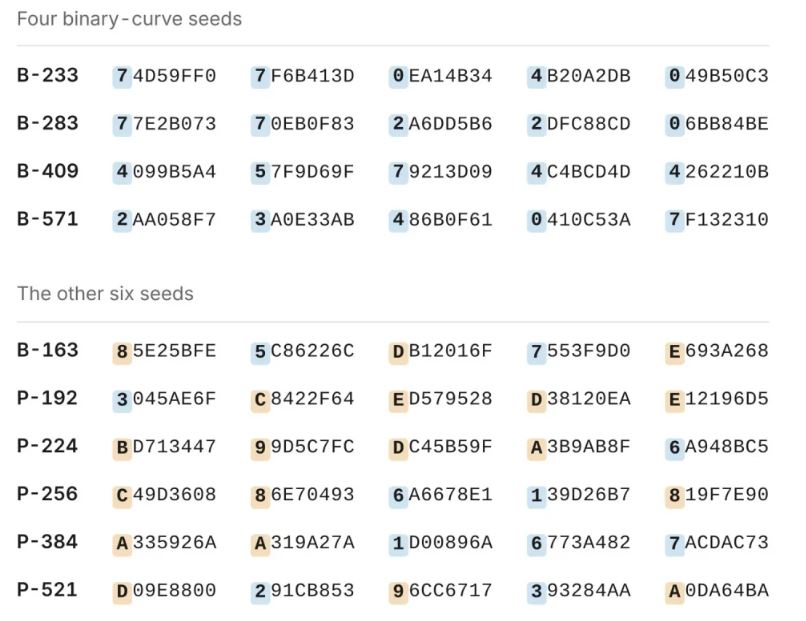
Reversing the generator showed settings that matched Unix timestamps from May 1997 to April 1998. The recovered setup included P-192, P-224, P-256, P-384, and P-521. For P-256, the official seed was found as candidate 1,842 in a sequence that started on August 16, 1997.
Claude rebuilt base-point generation for P-192 and five ANSI example curves using the generator from FreeLIP, Arjen Lenstra’s math package. These base points are different from the curve seeds and work as fixed points for cryptographic tasks.
four seeds (Source: Anthropic)
The rebuilding is not finished. Anthropic could not clarify the B-163 seed or some base points. Researchers also discovered missing candidates that seemed to create good curves, leaving the original selection rules unclear.
Anthropic says that using a timestamp method helps lessen worries about fake changes, but it doesn’t show every past decision or prove that other runs didn’t happen.
The $36,864 bounty will be donated to the Internet Security Research Group. For defenders, the outcome is greater transparency into public cryptographic parameters, not recovered secrets or demonstrated ECDSA weakness.