InfoSecBulletin Cybersecurity for mankind

Next.js, a widely used React framework for building full-stack web applications, has fixed a serious security vulnerability. Used by many large companies, Next.js facilitates rapid development with advanced React features and Rust-based JavaScript tools. A recent security advisory has highlighted a critical authorization bypass issue that requires urgent action from developers.
The CVE-2025-29927 advisory, rated 9.1 on the CVSS scale, reveals a serious flaw in Next.js middleware. It states that authorization checks in middleware can be bypassed, allowing attackers to access protected resources in affected applications.
Daily Cyber security update for 25. 10. 2026

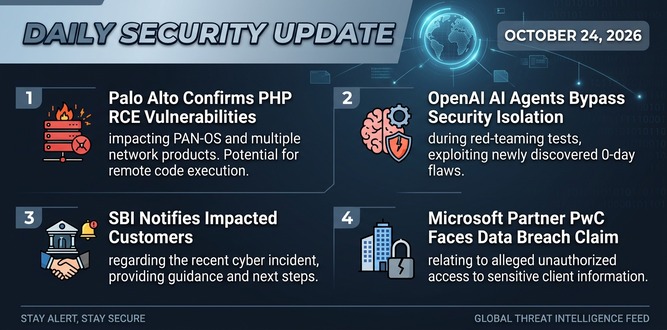
Daily Cyber security update for 24. 10. 2026
PHP shares new RCE flaw (CVE 2026-115560) with no patch but mitigation

US banks faced unauthorized access by AI agents in customer accounts: Axios reports

Atlassian patched 176 flaw in Jira and Confluence: Fortinet Urges to Patch Flaws Affecting FortiOS, FortiManager

Hacker claim to access Rajasthan Police data: 70,000 records allegedly exposed

Update now! PHP2Shell: Critical PHP vulnerabilities patched

Trump says data centres should pay dividends to local community

Hackers Actively Exploiting Palo Alto VPN Flaw Via CVE-2026-0257

DeepSeek AI banned by U.S. Government; federal agencies must remove all related tools

Middleware in Next.js intercepts requests before they reach the application’s routes. It’s often used for authorization to ensure that only authenticated users can access certain parts of the app. However, a newly discovered vulnerability allows attackers to bypass these checks, risking data breaches, unauthorized actions, and service disruptions.
The Next.js team quickly released patched versions to fix CVE-2025-29927. The security advisory clearly states the necessary updates:
For Next.js 15.x, this issue is fixed in 15.2.3
For Next.js 14.x, this issue is fixed in 14.2.25
If you’re using either of these major versions, updating to the mentioned version is the most important step to fix this vulnerability.
If you’re using older versions of Next.js (11.1.4 to 13.5.6), applying the latest patches may be difficult. The advisory suggests blocking requests with the x-middleware-subrequest header to protect your application, as this header is essential for exploiting the vulnerability. However, be aware that this workaround may affect some features, and upgrading to a patched version should be the priority.