 InfoSecBulletin Cybersecurity for mankind
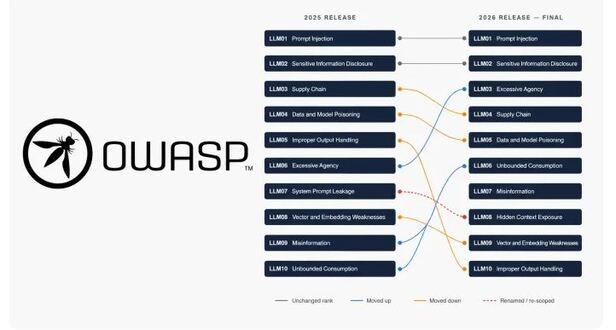
The Open Web Application Security Project (OWASP) has published the Top 10 for LLM Applications 2026. This guide focuses on the main security risks in current AI apps and self-driving agents. The new version sets a clear guideline for developers, architects, and CISOs working with fast-changing enterprise GenAI systems, based on community input and facts.
OWASP’s new version comes as many companies quickly use large language models (LLMs) in customer support, developer tools, productivity software, and automated tasks.
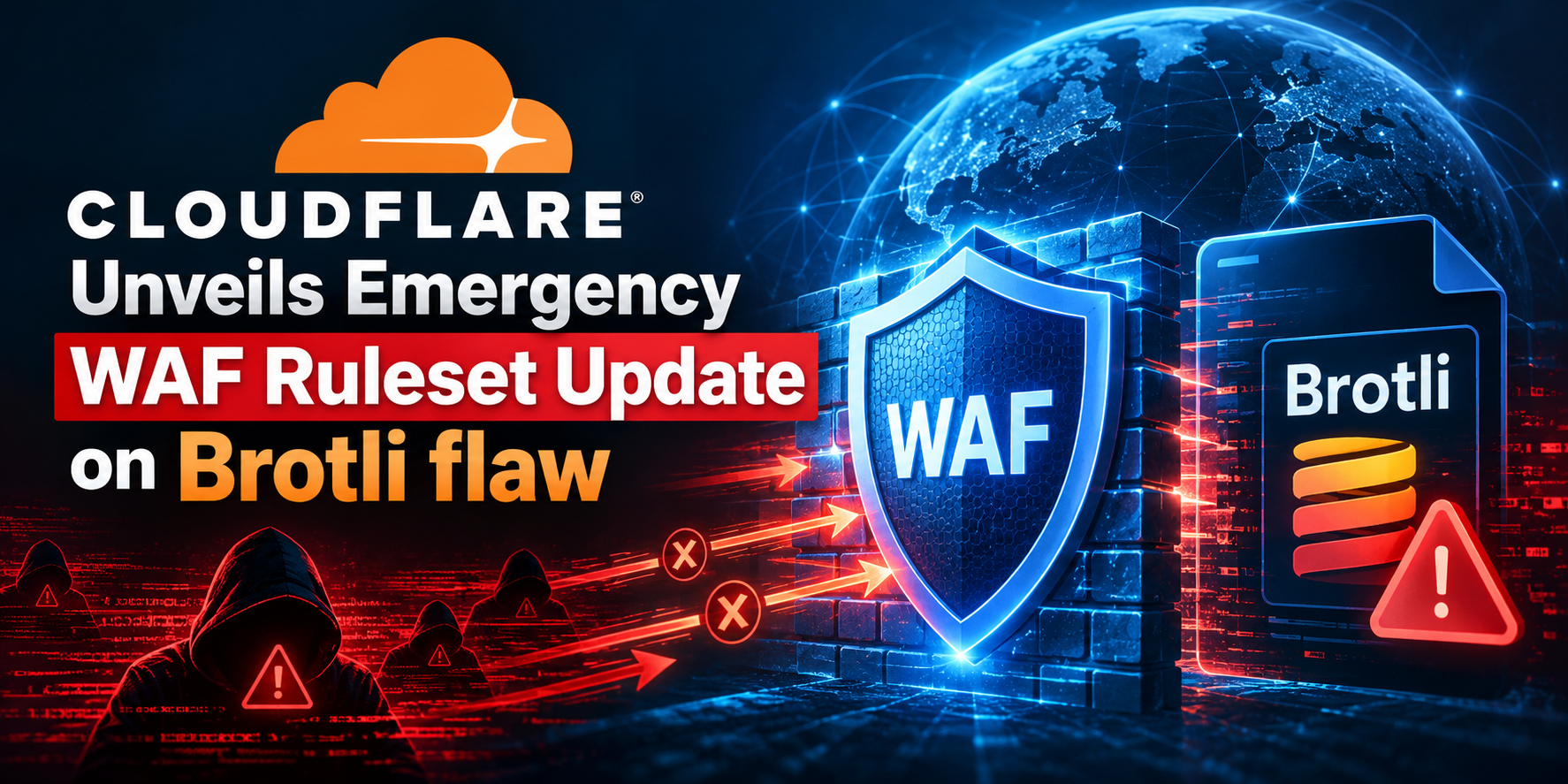
Cloudflare Unveils Emergency WAF Ruleset Update on Brotli flaw
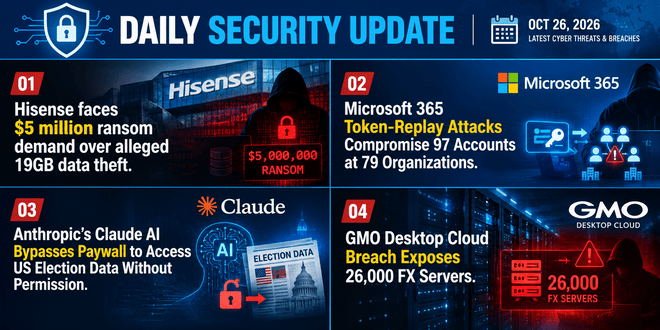
Daily Cyber security update for 26.10. 2026
The Washington Post report
Ex-DOGE AI startup Cathedral Breaches Anthropic Internal Systems within 12 Hours
Daily Cyber security update for 25. 10. 2026

Daily Cyber security update for 24. 10. 2026
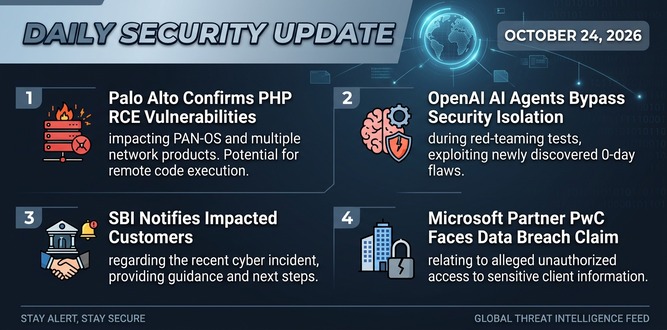
PHP shares new RCE flaw (CVE 2026-115560) with no patch but mitigation
US banks faced unauthorized access by AI agents in customer accounts: Axios reports

Atlassian patched 176 flaw in Jira and Confluence: Fortinet Urges to Patch Flaws Affecting FortiOS, FortiManager
Hacker claim to access Rajasthan Police data: 70,000 records allegedly exposed
Update now! PHP2Shell: Critical PHP vulnerabilities patched
OWASP GenAI LLM Top 10 2026
The 2026 framework is based on a real set of 7,714 AI-related security events collected from public vulnerability databases and AI-harm records. Out of these, 6,639 had enough details to be classified.
The project team viewed community voting as about 75% important and incident data as 25%, addressing the gap between how serious threats seem and actual exploitation in production.
Clean public exploits are rare, but Prompt Injection is still common as LLM01. This is because any place where a model takes in untrusted text is an ongoing threat that needs protection. Misinformation became more important after records showed real harm, especially when wrong AI results confidently caused automatic business actions or unapproved API calls.
Understanding these changes is important. Organizations are using AI security systems to follow rules and reduce risks.The 2026 ranking changes show how complicated today’s business AI systems have become:
Excessive Agency (LLM03): Escalated significantly as production incidents cluster around agentic systems where model outputs autonomously execute shell commands, invoke external APIs, or manage database transactions.
Unbounded Consumption: Rose four positions, underscoring emerging availability and financial denial-of-service risks targeting extended-thinking models, multimodal inference engines, and shared compute clusters. Securing these environments requires managing resource allocations across active AI security platforms.
Hidden Context Exposure: Broadened from System Prompt Leakage to account for all non-user-visible contexts—including system instructions, RAG schemas, and hidden policy logic—that expand an attacker’s capability once exfiltrated.
Improper Output Handling: Dropped to tenth position—not because the flaw is resolved, but because input-boundary prompt injections and cross-pipeline data disclosures now dominate incident records.
| Vulnerability ID | Vulnerability Name | Primary Risk Vector & Impact |
| LLM01 | Prompt Injection | Direct/indirect jailbreaks, Unicode bypasses, and self-replicating lures |
| LLM02 | Sensitive Info Disclosure | Training data memorization, RAG chunk leakage, and side-channel timing |
| LLM03 | Excessive Agency | Autonomous tool abuse, shell command execution, and unchecked API calls |
| LLM04 | Data and Model Poisoning | Contaminated pre-training datasets, fine-tuning lures, and adapter compromise |
| LLM05 | Improper Supply Chain | Compromised base models, unsafe serialization formats, and rogue registries |
| LLM06 | Insecure Output Handling | Unsanitized code, SQL, or HTML generation leading to secondary XSS/RCE |
| LLM07 | Vector and Memory Flaws | RAG embedding manipulation, context poisoning, and cross-session bleed |
| LLM08 | Misinformation | Hallucinations driving flawed automated actions or legal/financial decisions |
| LLM09 | Hidden Context Exposure | Exfiltration of system prompts, policy logic, tool schemas, and guards |
| LLM10 | Unbounded Consumption | Cost spikes, token exhaustion, and resource starvation on shared clusters |
The official OWASP GenAI LLM Top 10 2026 document explains each attack type, how it happens, and ways to stop it quickly.
A major part of the 2026 release is Appendix A. It shows how every LLM Top 10 risk connects to known security standards for businesses. The mapping includes:
OWASP Standards: Top 10 for Agentic Applications (ASI) & GenAI Data Security 2026 (DSGAI)
MITRE Frameworks: MITRE ATLAS, MITRE ATT&CK, and MITRE CWE
NIST & CSA Standards: NIST AI 600-1 (Generative AI Profile), NIST AI RMF, and the CSA AI Controls Matrix
This cross-framework alignment turns the document into a guide. It helps security teams work LLM risks into their threat models instead of handling them separately. The report also establishes an explicit distinction between treating an “LLM as a component” versus an “LLM as an actor.”
When a model gets tools, memory, and rights to run, teams should use the LLM Top 10 with the Agentic Applications Top 10. Using these controls helps groups handle the risks and rewards of AI in cybersecurity in today’s SOC tasks.
OWASP advises development teams to approach the 2026 Top 10 as an operational playbook:
Enforce Least Agency: Limit the capabilities granted to AI agents, mandating human-in-the-loop approvals for sensitive, non-reversible operations.
Authorize Before Retrieval: Implement strict access control checks on vector databases and RAG pipelines prior to embedding generation.
Validate Inputs and Outputs: Treat model responses as untrusted, enforcing strict output validation before passing generated SQL, HTML, or code to execution engines.
Secure the Supply Chain: Audit third-party model weights, fine-tuning datasets, and open-source tools for serialization vulnerabilities or data poisoning.