 InfoSecBulletin Cybersecurity for mankind

Sygnia’s recent report highlights the changing strategies of ransomware groups targeting VMware ESXi appliances. These attackers exploit vital virtual infrastructure to disrupt operations and remain hidden in compromised networks.
ESXi appliances have become prime targets due to their role in hosting vital virtual machines. “Damaging them renders virtual machines inaccessible, severely disrupting the business operations of affected organizations,” notes Sygnia.
Researchers show new technique to bypass AI safety guardrails in Grok and Gemini

About thousands of leaked AWS keys Held Full Admin Rights

US Bank investigates LockBit’s Data Breach Claims

Five new malware families actively targeting Asian Gov.t infra

T-Mobile Cuts Cables to Remove Chiness Salt Typhoon Hackers from Network

Splunk, Zyxel Patch Multiple Flaws Enabling RCE and Root Command Execution

“Zombie Card” attack revels expired Visa card may be used for contactless payments

Critical Zimbra RCE Flaw Actively Exploited in the Wild
Operation CameraSwarm
A single hacker compromise 1400+ Dahua camera worldwide

Cl0p Ransomware Listed 40+ Victims of PTC Windchill Campaign

Ransomware operators use ESXi devices to secretly tunnel malicious traffic within networks, often avoiding detection because of minimal monitoring.
The report highlights SSH tunneling as a tactic where attackers create a semi-persistent backdoor by using stolen admin credentials or vulnerabilities to access ESXi devices.
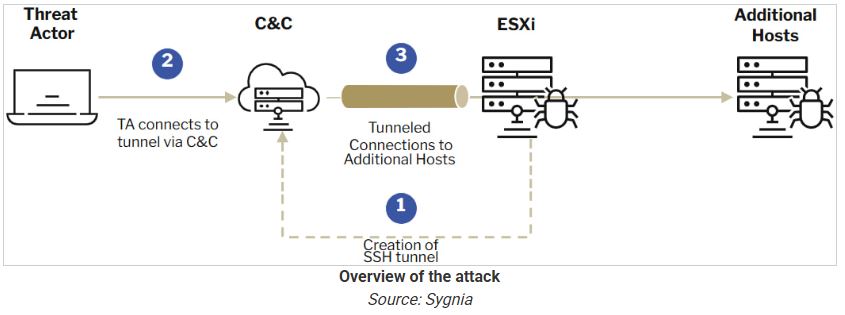
Threat actors use SSH to create a remote port-forwarding SOCKS tunnel, allowing them to mix malicious traffic with legitimate activity.
Sygnia explains, “Since ESXi appliances are resilient and rarely shutdown unexpectedly, this tunneling serves as a semi-persistent backdoor within the network.”
This method lets attackers avoid security measures and keep access for a long time.
ESXi’s logging structure complicates forensic investigations. Unlike traditional syslogs, ESXi organizes logs by activity, spreading critical events across multiple files, such as /var/log/shell.log, /var/log/auth.log, and /var/log/hostd.log. Sygnia emphasizes, “Configuring syslog forwarding from the ESXi server to an external syslog server can solve the issue.”
The report shows how Abyss Locker ransomware exploits ESXi appliances. Attackers exploited ESXi devices and NAS for network access, highlighting the importance of strong monitoring and defense strategies.