InfoSecBulletin Cybersecurity for mankind

As a new month begins, fresh information has surfaced regarding the exploitation of the MOVEit bug. The HHS has recently provided an update, revealing that the personal information of a minimum of 100,000 individuals may have been compromised due to an assault on one of its contracted entities. Notably, the Anonymous Sudan threat group has exhibited heightened activity in recent times, asserting responsibility for multiple attacks on various organizations within the United States. Recognizing the severity of the situation, the CISA has issued a warning regarding these activities. Shifting focus, the BlackCat ransomware has adopted malvertising campaigns that exploit WinSCP. To keep you informed, here are the key highlights from the weekend.
- The HHS has revealed that hacking incidents targeting its third-party vendors have resulted in the compromise of personal information for a minimum of 100,000 individuals. These incidents involved the exploitation of the MOVEit vulnerability.
- The CISA has issued a warning concerning ongoing Distributed Denial-of-Service (DDoS) attacks that have affected various U.S. organizations across different industries. The Anonymous Sudan group has claimed responsibility for the attacks on the Treasury Department’s Electronic Federal Tax Payment System and the Commerce Department.
- Morphisec Labs has uncovered a GuLoader campaign targeting law firms (46.4%), investment firms (17.9%), and healthcare firms (21.4%) in the United States. This campaign has been active since April.
- Avast has released a free decryptor for the Akira ransomware, allowing victims to recover their data without paying a ransom. The decryptor is available in both 64-bit and 32-bit Windows architectures.
- Trend Micro reports that the BlackCat ransomware group is utilizing malvertising campaigns to distribute malware. They attract victims by creating fake pages that mimic the official website of the WinSCP file-transfer application.
- Over 200,000 WordPress websites are vulnerable to ongoing attacks targeting a critical vulnerability in the Ultimate Member plugin. Exploiting this bug grants attackers the ability to add a new user account to the admin group.
- ASEC security experts have observed that Crysis ransomware operators are now utilizing the Venus ransomware to target externally exposed remote desktop services. These attacks are launched via Remote Desktop Protocol (RDP).
- An international police operation has successfully dismantled an organized crime operation that specifically targeted the elderly with scam phone calls. The U.K.’s National Crime Agency (NCA) arrested 70 individuals and seized $174,000 in cash, among other assets.
- Uptycs has discovered a new Windows-based information stealer called Meduza Stealer. This stealthy malware aims to evade detection by security software and is capable of stealing a wide range of valuable data, including login credentials, browsing history, and cryptocurrency wallets.
- Cybersecurity researchers have developed Snappy, a new tool designed to detect rogue WiFi access points that attempt to steal data. Snappy can also identify access points created using Airbase-ng, a tool commonly used by attackers to create fake access points.
Daily Cyber security update for 25. 10. 2026

Daily Cyber security update for 24. 10. 2026
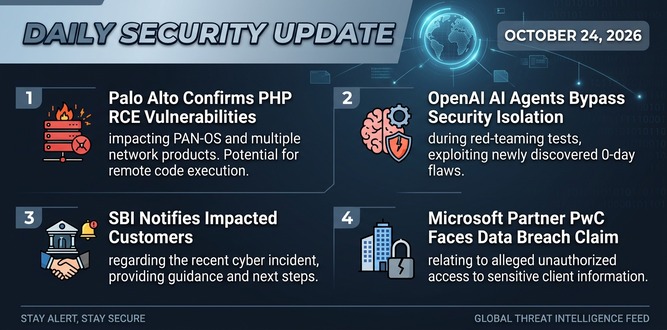
PHP shares new RCE flaw (CVE 2026-115560) with no patch but mitigation

US banks faced unauthorized access by AI agents in customer accounts: Axios reports

Atlassian patched 176 flaw in Jira and Confluence: Fortinet Urges to Patch Flaws Affecting FortiOS, FortiManager

Hacker claim to access Rajasthan Police data: 70,000 records allegedly exposed

Update now! PHP2Shell: Critical PHP vulnerabilities patched

Trump says data centres should pay dividends to local community

Hackers Actively Exploiting Palo Alto VPN Flaw Via CVE-2026-0257

DeepSeek AI banned by U.S. Government; federal agencies must remove all related tools