InfoSecBulletin Cybersecurity for mankind
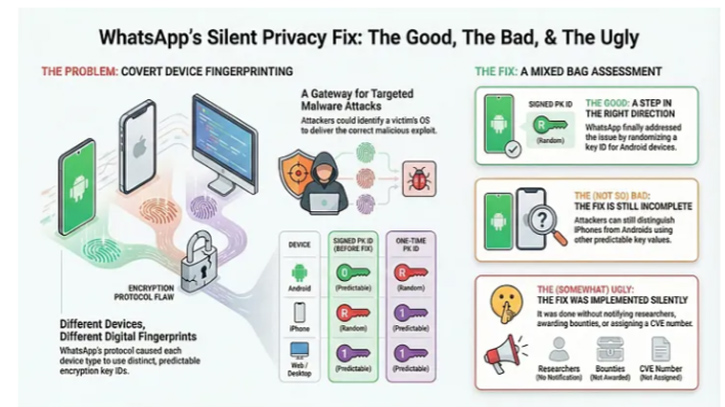
Meta’s WhatsApp is now silently fixing security issues that could reveal users’ operating system details to attackers. Privacy issues impact over 3 billion users, allowing attackers to gather information before launching malware attacks.
Understanding the Fingerprinting Threat:
Daily Cyber security update for 25. 10. 2026

Daily Cyber security update for 24. 10. 2026
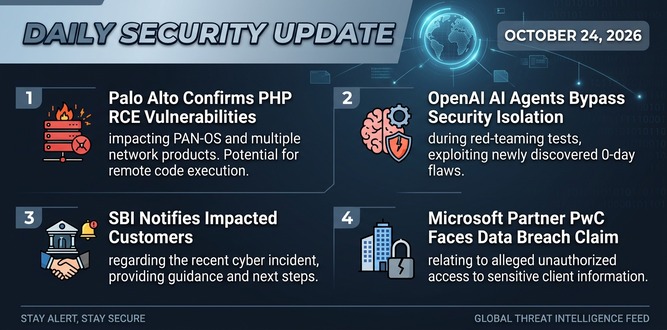
PHP shares new RCE flaw (CVE 2026-115560) with no patch but mitigation

US banks faced unauthorized access by AI agents in customer accounts: Axios reports

Atlassian patched 176 flaw in Jira and Confluence: Fortinet Urges to Patch Flaws Affecting FortiOS, FortiManager

Hacker claim to access Rajasthan Police data: 70,000 records allegedly exposed

Update now! PHP2Shell: Critical PHP vulnerabilities patched

Trump says data centres should pay dividends to local community

Hackers Actively Exploiting Palo Alto VPN Flaw Via CVE-2026-0257

DeepSeek AI banned by U.S. Government; federal agencies must remove all related tools

Security researchers found that WhatsApp’s end-to-end encryption for multiple devices unintentionally exposes device metadata. Each device has its own encryption session with a unique key, allowing for easy identification.
Bad actors can leverage and use WhatsApp as an attack vector for the query WhatsApp servers for encryption material and extract device-specific information without any user interaction. This reconnaissance capability poses significant risks to users worldwide.
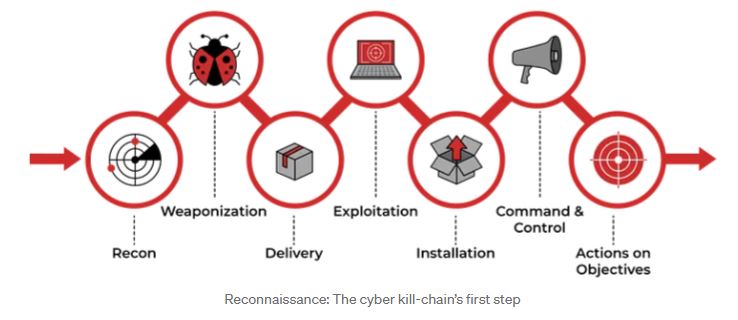
Recent research shows that ID generation differences enable attackers to identify victims’ operating systems, distinguishing between Android and iPhone. This identification capability is crucial for advanced persistent threat (APT) actors deploying platform-specific zero-day exploits.
Sending an Android exploit to an iPhone would not only fail but also potentially alert victims and compromise sophisticated attack infrastructure worth millions of dollars.
Accurate device identification is crucial for threat actors to maintain operational security before attacks.
Security analysts found changes in how Android generates Signed PK IDs using proprietary research tools. The parameter now creates a random value each month instead of starting at zero and increasing, making device identification harder.
The One-Time PK ID parameter is still flawed. iPhone initialization values vary greatly from Android’s 24-bit random range, allowing precise device identification.
This partial remediation represents progress but leaves critical gaps in protection.
WhatsApp fixed the issue without informing the original reporters or assigning CVE identifiers. WhatsApp issued a bug bounty in one case but didn’t assign a CVE due to low severity.
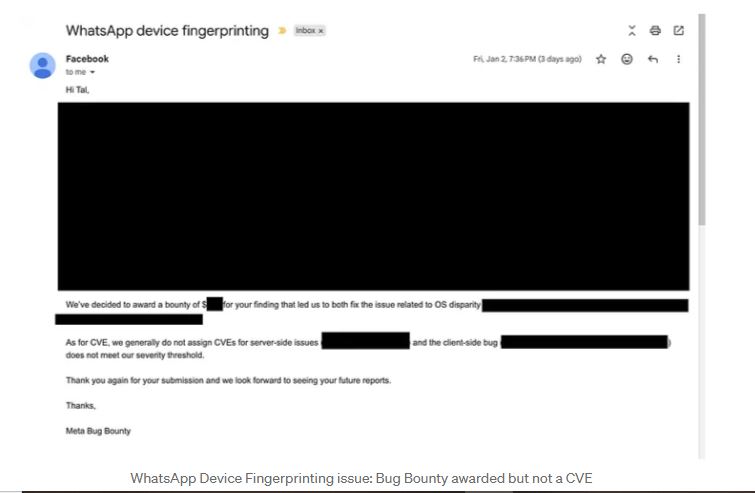
Security experts believe CVE documentation is crucial for communication in the security community, not just a way to label issues, and that severity is accurately represented in CVSS scores.
Researcher advised that Meta should focus on thorough fixes and notify researchers and assign CVEs to show commitment to security transparency.